




People often ask whether Minnesota has a “three strikes” law. The short answer is that Minnesota does not use a California-style three-strikes system where a third conviction automatically triggers a mandatory life sentence. However, repeat convictions can still dramatically increase sentencing exposure in Minneapolis and throughout Minnesota.
Instead of a single three-strikes rule, Minnesota uses a mix of sentencing guidelines, offense-specific enhancement statutes, and repeat-offender or dangerous-offender provisions. Prior convictions can affect how a new charge is filed, whether a misdemeanor becomes a felony, how the sentencing guidelines apply, and whether the prosecution asks the judge for a longer sentence.
At Keyser Law, P.A., we represent people facing serious criminal charges in Minneapolis and across Minnesota. When a client has prior convictions, our team looks closely at how each prior is counted, whether the state is relying on the correct statute, and whether the alleged enhancement actually applies.
Does Minnesota Have a Three Strikes Law?
Minnesota does not have a traditional three strikes law like California’s. There is no universal rule that automatically sends a person to prison for life after a third conviction.
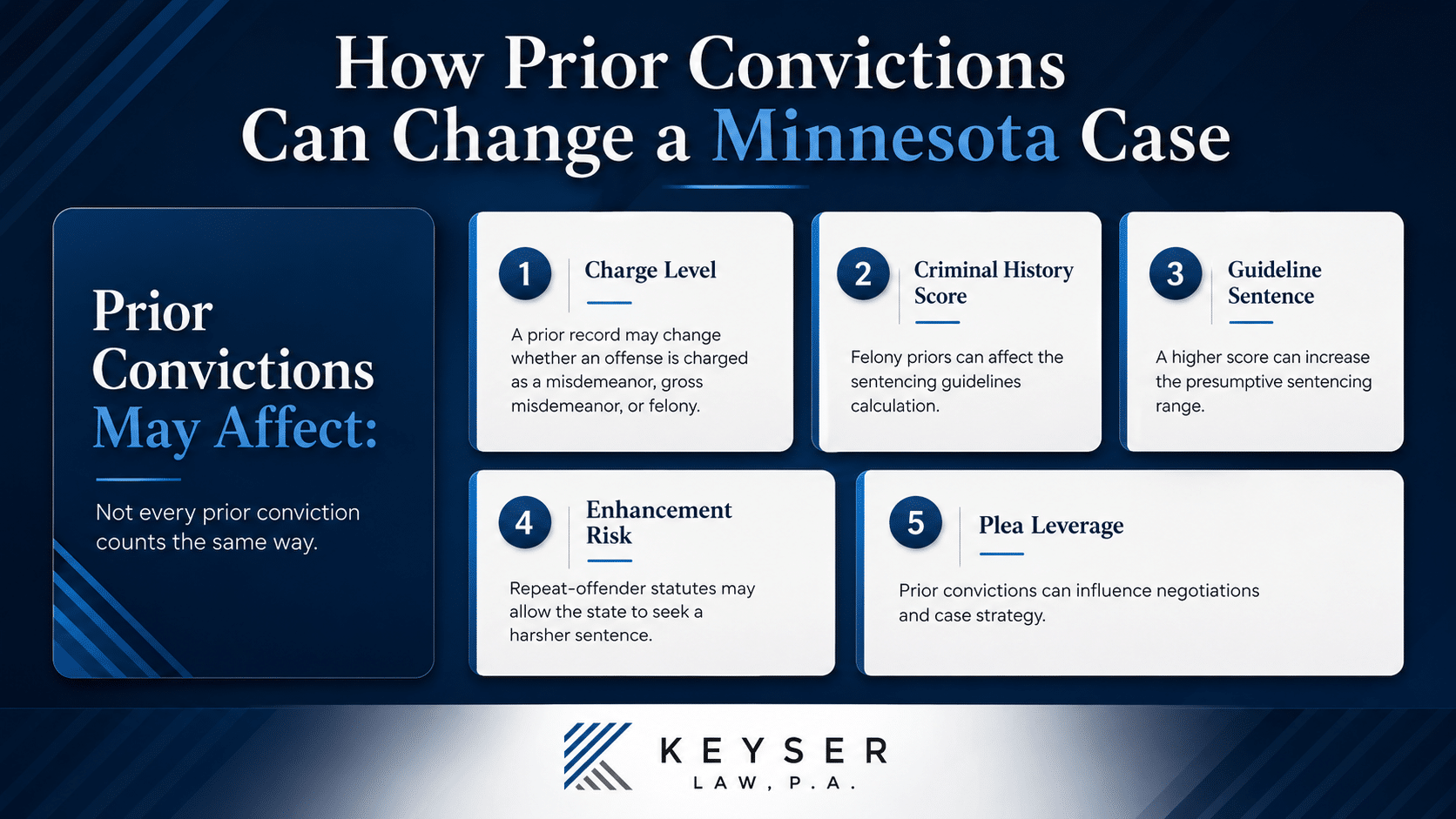
That does not mean repeat offenses are treated lightly. Minnesota law allows prior convictions to increase penalties in several ways. A prior record may raise a person’s criminal history score under the Minnesota Sentencing Guidelines. It may also allow prosecutors to charge a higher-degree offense or seek an aggravated sentence under Minnesota’s repeat-offender laws.
For repeat offenders, the key question is rarely, “Is this your third strike?” The better question is, “How is the state using your prior record in this case?”
How Minnesota’s Career Offender Law Can Increase a Sentence
One of the most important repeat-offender statutes in Minnesota is Minnesota Statutes § 609.1095, which addresses increased sentences for certain dangerous and repeat felony offenders.
Under the career offender provision, a judge may impose a longer sentence when a person has five or more prior felony convictions, and the current felony is part of a pattern of criminal conduct. This does not automatically mean a life sentence, but it can allow the court to go above the normal sentencing guidelines and impose a sentence up to the statutory maximum for the offense.
That distinction matters. A prior record does not simply “add time” in a mechanical way. It can change the sentencing range, give the prosecution leverage, and increase the risk that the judge will impose a harsher sentence than the guidelines would otherwise call for.
How Minnesota’s Dangerous Offender Law Works
Minnesota’s dangerous offender provision is another part of the same repeat-offender statute. It applies in a narrower set of cases involving violent felony offenses.
Generally, the dangerous offender provision may come into play when a person is convicted of a violent crime, has two or more prior convictions for violent crimes, and the court finds that the person is a danger to public safety. If those findings are made, the judge may sentence above the presumptive guidelines range.
These cases require close review. The defense may need to challenge whether the current offense qualifies, whether the prior convictions are properly classified, whether the state has proved the required pattern-or-danger finding, and whether an aggravated sentence is legally justified.
When a Repeat DWI Becomes a Felony in Minnesota
Repeat-offender enhancement is not limited to violent crimes. One of the most common examples is felony DWI.
Under Minnesota’s first-degree DWI law, a DWI can become a felony if the person has three or more qualified prior impaired driving incidents within the relevant ten-year period, has a prior felony DWI conviction, or has certain prior felony impaired-driving-related convictions. A first-degree DWI carries serious felony exposure, including possible prison time, fines, long-term probation, license consequences, and other collateral penalties.
Because DWI enhancements often depend on how prior convictions, license revocations, and impaired-driving incidents are counted, a repeat DWI case should be reviewed carefully. A mistake in counting priors can change the charge’s degree and the penalties at stake.
Other Minnesota Charges That Can Become More Serious With Priors
Repeat-offender consequences can appear across many Minnesota criminal charges. Prior convictions may affect the charging level, sentencing range, plea negotiations, and the prosecutor’s decision to seek an upward departure.
Common examples include:
- Domestic assault: A new domestic assault can become a felony when it occurs within ten years of two or more qualifying domestic violence-related convictions or adjudications.
- Theft and property crimes: Prior theft-related convictions and the value of the property involved can affect whether a case is charged as a misdemeanor, gross misdemeanor, or felony.
- Drug offenses: Prior drug convictions and the degree of the current offense can increase charging and sentencing exposure.
- Assault, robbery, and burglary: A history of violent or felony-level offenses may affect sentencing and may be relevant to dangerous offender arguments.
- Firearm and weapons offenses: Certain prior convictions can trigger separate mandatory minimum sentences or make firearm possession itself a serious felony.
Because these rules vary by offense, a person facing a repeat charge should not assume the state’s calculation is correct. The prior case, date, jurisdiction, plea, sentence, and final disposition can all matter.
How Prior Convictions Affect a Minnesota Sentence
In Minnesota felony cases, prior convictions often affect the criminal history score used under the sentencing guidelines. The higher the criminal history score, the higher the presumptive sentencing range may become. Prior record can also affect whether the guidelines call for a stayed sentence, probation, or an executed prison sentence.
But not every old case counts the same way. Out-of-state convictions, older convictions, juvenile adjudications, stayed sentences, misdemeanor enhancements, and cases with unclear records may need to be reviewed before the sentencing exposure is accepted as accurate.
Repeat cases can also create supervision issues. A person who is sentenced to probation may later face a violation allegation, while a person released from prison may face supervised release consequences. Those rules are different, which is why our related article on probation vs. parole in Minnesota may also be helpful.
Why Early Defense Strategy Matters in a Repeat-Offense Case
When someone has prior convictions, the defense strategy often needs to begin before sentencing. The goal may be to challenge the charge level, contest whether a prior conviction qualifies, negotiate away an enhancement, argue against an upward departure, or present mitigation that supports a lower sentence.
Early involvement also helps the defense understand what the prosecution is likely to argue. In some cases, the most important work is not only fighting the new allegation, but also preventing the prior record from being used in the harshest possible way.
An experienced Minneapolis criminal defense lawyer can review the complaint, criminal history, sentencing guidelines, plea history, and enhancement allegations before the case moves too far forward.
Facing a Second or Third Charge in Minneapolis?
If you are facing a second, third, or later criminal charge, the sentencing exposure may be much higher than it first appears. Minnesota may not have a simple three-strikes law, but prior convictions can still affect the charge, the plea offer, the sentencing guidelines, and the risk of prison.
Christopher Keyser and the team at Keyser Law, P.A. defend clients facing serious and repeat criminal charges throughout Minneapolis and Minnesota. We examine how each prior conviction is being used, whether the state can prove the enhancement it claims, and what options may exist to protect your future.
Contact Keyser Law, P.A. today for a confidential consultation.
