




Entrapment can be a defense in a Minnesota drug case when the government does more than investigate suspected criminal activity and instead pressures someone into committing a crime they were not already willing to commit. This issue often comes up when an undercover officer, confidential informant, or cooperating witness initiates contact, pushes for a drug sale or purchase, or uses repeated requests to overcome hesitation.
Not every sting operation is entrapment. Police may use undercover tactics, controlled buys, and informants in drug investigations. The key question is whether law enforcement merely gave a willing person the opportunity to commit a crime, or whether the government created the crime by inducing someone who was not predisposed to commit it.
At Keyser Law, P.A., we defend clients facing drug charges in Minneapolis and throughout Minnesota. If you believe an informant or undercover officer pushed you into a drug offense, a Minneapolis drug crime lawyer can review how the contact began, what was said, and whether the government crossed the line.
What Entrapment Means in a Minnesota Drug Case
Entrapment occurs when law enforcement induces a person to commit a crime who was not otherwise predisposed to commit it. In a drug case, the issue is not simply whether police were involved. The issue is whether the government’s conduct went beyond providing an opportunity and became pressure, persuasion, or manipulation.
For example, an entrapment defense may be relevant if an informant repeatedly asked for drugs after the person said no, appealed to sympathy or friendship, offered unusually strong incentives, or pushed the person into a transaction that did not originate with them. The defense focuses on the government’s role in creating the offense and the accused person’s state of mind before the government became involved.
How Minnesota’s Entrapment Test Works
Minnesota follows a subjective entrapment test. First, the defense must raise the issue by showing government inducement. That usually means showing something more than a simple opportunity to commit the offense. The conduct may involve persuasion, pressure, repeated requests, or similar tactics.
Once the defense raises entrapment, the burden shifts to the prosecution. To obtain a conviction, the state must prove beyond a reasonable doubt that the accused was predisposed to commit the crime before the government induced the conduct. In other words, the prosecution must show the person was already ready and willing to commit the offense, not merely talked into it by police or an informant.
Minnesota courts have described this framework in cases such as State v. Vaughn, which explains that the defendant must first show government inducement and the state must then prove predisposition beyond a reasonable doubt.
Entrapment vs. a Lawful Sting Operation
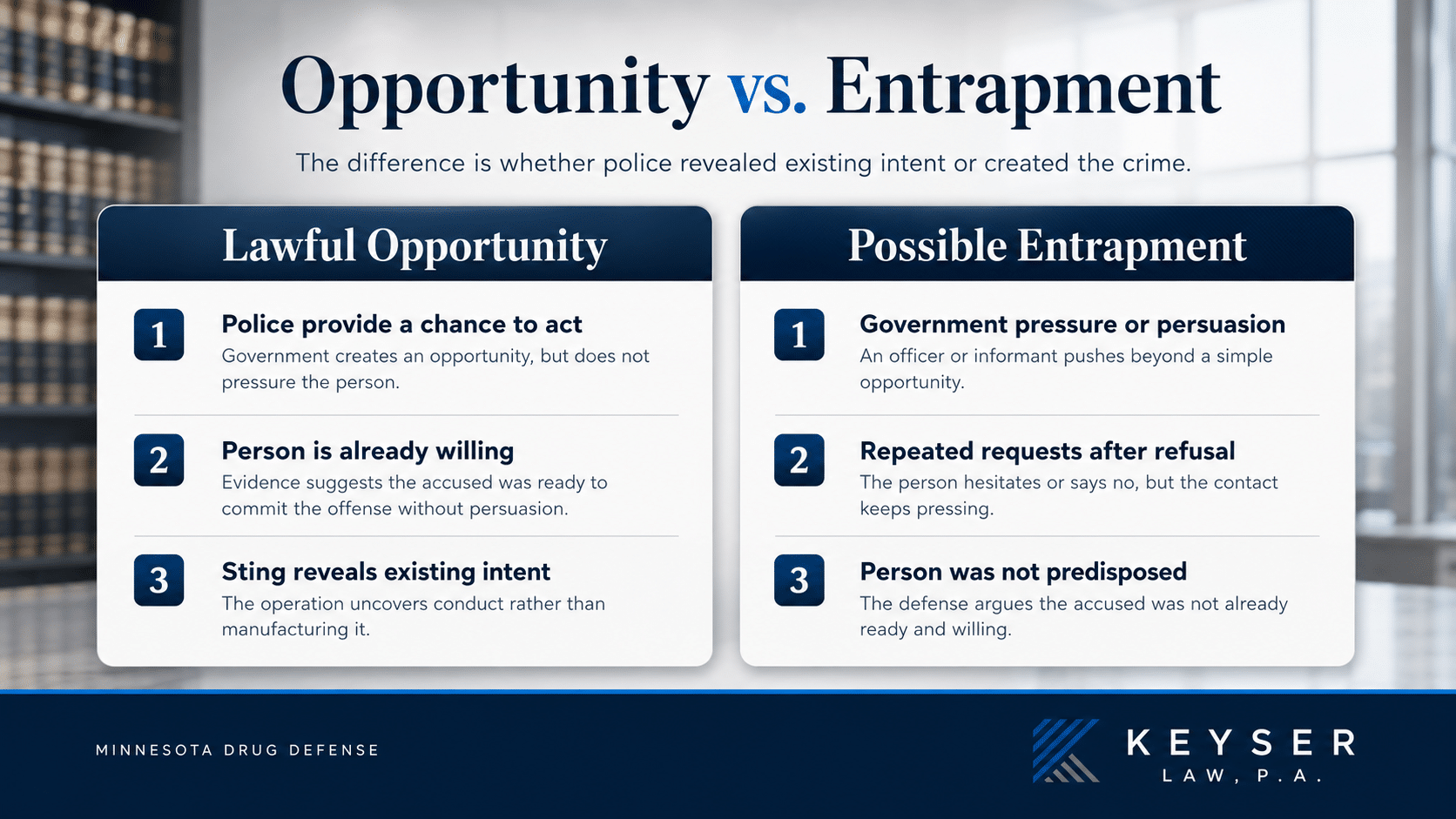
A lawful sting operation is not the same thing as entrapment. Police may pose as buyers or sellers, use controlled purchases, arrange recorded communications, and work with informants. Those tactics may be lawful when they reveal a crime that a person was already willing to commit.
The line may be crossed when the government supplies the pressure, not just the opportunity. Courts may consider who first suggested the transaction, how often the informant or officer contacted the accused, whether the accused initially refused, whether personal relationships were exploited, and whether the government used unusual incentives to overcome the accused’s reluctance.
This distinction matters because many drug cases involve some form of government participation. The fact that an undercover officer or informant was involved does not automatically create an entrapment defense. The defense depends on the details of the contact, the accused’s response, and evidence of predisposition.
When an Entrapment Defense May Apply to Drug Charges
An entrapment defense may apply when the government, not the accused person, started and drove the alleged drug transaction. The type of substance matters for charging and penalties, but the entrapment question usually turns more on the conduct of the police, informants, and the accused.
Possible signs of entrapment may include:
- An informant or undercover officer reached out first.
- The accused initially refused or hesitated.
- The government contact kept pushing after a refusal.
- An informant used friendship, sympathy, fear, or money to change the person’s mind.
- The accused person had no plan to buy or sell drugs before the government became involved.
- Messages, calls, or recordings show repeated pressure from the government side.
Because Minnesota drug charges depend on the type and amount of controlled substance involved, the defense should also review how the charge was graded. Minnesota law classifies controlled substances into schedules under Minnesota Statutes § 152.02, and that classification can affect the seriousness of the charge and potential penalties.
Why Predisposition Is Often the Central Issue
Predisposition is often where an entrapment defense is won or lost. The prosecution may argue that the accused person was already willing to commit the crime because they responded quickly, knew how to complete the transaction, used drug-related language, had prior drug history, or appeared familiar with the process.
The defense may argue the opposite: that the accused person hesitated, refused, lacked prior intent, was repeatedly pressured, or acted only because of the informant’s persistence. Text messages, call logs, recordings, social media messages, and informant communications can be critical.
A Minneapolis criminal defense lawyer can examine whether the state is relying on assumptions about predisposition rather than proof. The difference matters because the government must prove predisposition beyond a reasonable doubt once entrapment has been properly raised.
What Evidence Matters in an Entrapment Defense?
Entrapment cases often depend on the timeline. Your defense team may need to know who initiated contact, what was said, how often the government contact followed up, whether there were refusals, and whether the alleged transaction changed over time.
Important evidence may include:
- Text messages and direct messages
- Call logs and voicemails
- Audio or video recordings
- Controlled-buy reports
- Informant agreements or payment records
- Police reports and surveillance notes
- Prior communications between the accused person and the informant
These details can show whether the government simply observed criminal conduct or actively manufactured it.
What to Do If You Think You Were Set Up
If you believe you were set up by police or an informant, do not try to explain everything to law enforcement on your own. Statements about how the transaction happened may later be used to argue that you were predisposed to commit the offense.
Instead, write down what you remember while it is fresh. Note who contacted you first, when the contact began, what was requested, whether you said no, what pressure was used, and whether anything was promised. Save texts, call logs, messages, and screenshots. Do not delete anything or contact the informant to confront them.
The Minnesota Judicial Branch provides general information about the criminal court process in Minnesota, but an entrapment defense requires a fact-specific legal review. A defense lawyer can compare your account against the government’s evidence and determine whether entrapment should be raised.
Talk to a Minneapolis Drug Crime Lawyer About Entrapment
Entrapment is a powerful defense when the facts support it, but it is not automatic just because an informant or undercover officer was involved. The defense depends on inducement, predisposition, and the specific communications that led to the alleged drug offense.
Christopher Keyser and the team at Keyser Law, P.A. defend clients facing serious drug charges throughout Minneapolis and Minnesota. We review how the investigation began, whether police or informants crossed the line, how the charge was graded, and what evidence may support a defense.
If you believe you were pressured, pushed, or set up in a Minnesota drug case, contact Keyser Law, P.A. today for a confidential consultation.
Frequently Asked Questions About Entrapment in Minnesota Drug Cases
Is being set up the same as entrapment?
Not always. A person may feel set up any time police use an informant or undercover officer, but entrapment requires more. The defense usually depends on whether the government induced the offense and whether the accused person was already predisposed to commit it.
Can police use informants in Minnesota drug cases?
Yes. Police may use informants, controlled buys, and undercover operations. Those tactics become legally vulnerable when the government does more than provide an opportunity and instead pressures or persuades someone who was not already willing to commit the offense.
Who decides whether entrapment applies?
Entrapment can be decided by a judge or jury depending on how the defense is raised and the choices made in the case. Because the decision can affect trial strategy, the issue should be discussed carefully with a criminal defense attorney.
