




Yes. You can be arrested for drug possession in Minnesota even if the drugs allegedly belonged to someone else. Prosecutors do not always have to prove that you bought the drugs, owned them, or personally brought them into the car, apartment, hotel room, or shared space where officers found them. The more important question is whether the state can prove you knowingly possessed or controlled the substance.
That distinction matters in shared-space drug cases. Drugs found in a vehicle, bedroom, backpack, purse, kitchen, closet, or common area can lead to more than one person being questioned, arrested, or charged. But being nearby is not the same thing as being guilty.
At Keyser Law, P.A., we examine whether police and prosecutors are relying on actual evidence of possession or simply assuming guilt because someone was close to the drugs. If you were arrested after drugs were found in a shared space, a Minneapolis drug crime lawyer can review whether the state can prove knowledge, access, and control.
Ownership Is Not Always the Main Issue in a Minnesota Drug Possession Case
One of the most common misunderstandings in drug possession cases is that the state must prove who owned the drugs. In many cases, the issue is not ownership. The issue is possession.
A person may be accused of possession even when the drugs were not found in their pocket, purse, hand, or personal bag. Minnesota law recognizes both actual possession and constructive possession. Actual possession generally means the substance was physically on the person. Constructive possession applies when the substance is elsewhere, but the state claims the person knowingly exercised control over it.
That means a friend saying “those drugs are mine” does not automatically end the case for everyone else. It may help, but prosecutors may still argue that another person knew about the drugs and had control over where they were found.
What Constructive Possession Means in Minnesota
Constructive possession is the theory prosecutors use when drugs are found somewhere other than on a person’s body. Minnesota courts have described constructive possession as a fact-specific doctrine used when the state cannot prove actual physical possession at the time of arrest, but claims the defendant continued to exercise dominion and control over the substance.
In general, the state may try to prove constructive possession in one of two ways:
- The drugs were found in a place under the defendant’s exclusive control where other people did not normally have access.
- If other people had access to the area, other evidence creates a strong probability that the defendant was consciously exercising dominion and control over the drugs.
This is why the details matter. A substance hidden in a private drawer, locked container, or personal bedroom creates a different case than a substance found on a coffee table, under a passenger seat, or in a shared kitchen.

Why Being Near Drugs Is Not Automatically Enough
Proximity alone should not be treated as proof of possession. Sitting near drugs, being present in a room, riding in a vehicle, or knowing someone who had drugs does not automatically prove that you knowingly controlled the substance.
The state must connect the accused person to the drugs through evidence. That may include where the substance was found, whether the person had access to that location, whether the person made statements, whether personal items were nearby, whether fingerprints or DNA exist, whether the drugs were in plain view, and whether other facts suggest control.
For the defense, the goal is often to separate presence from possession. Were you merely there, or can the state prove you knowingly exercised control over the substance? That difference can determine whether a drug possession charge holds up.
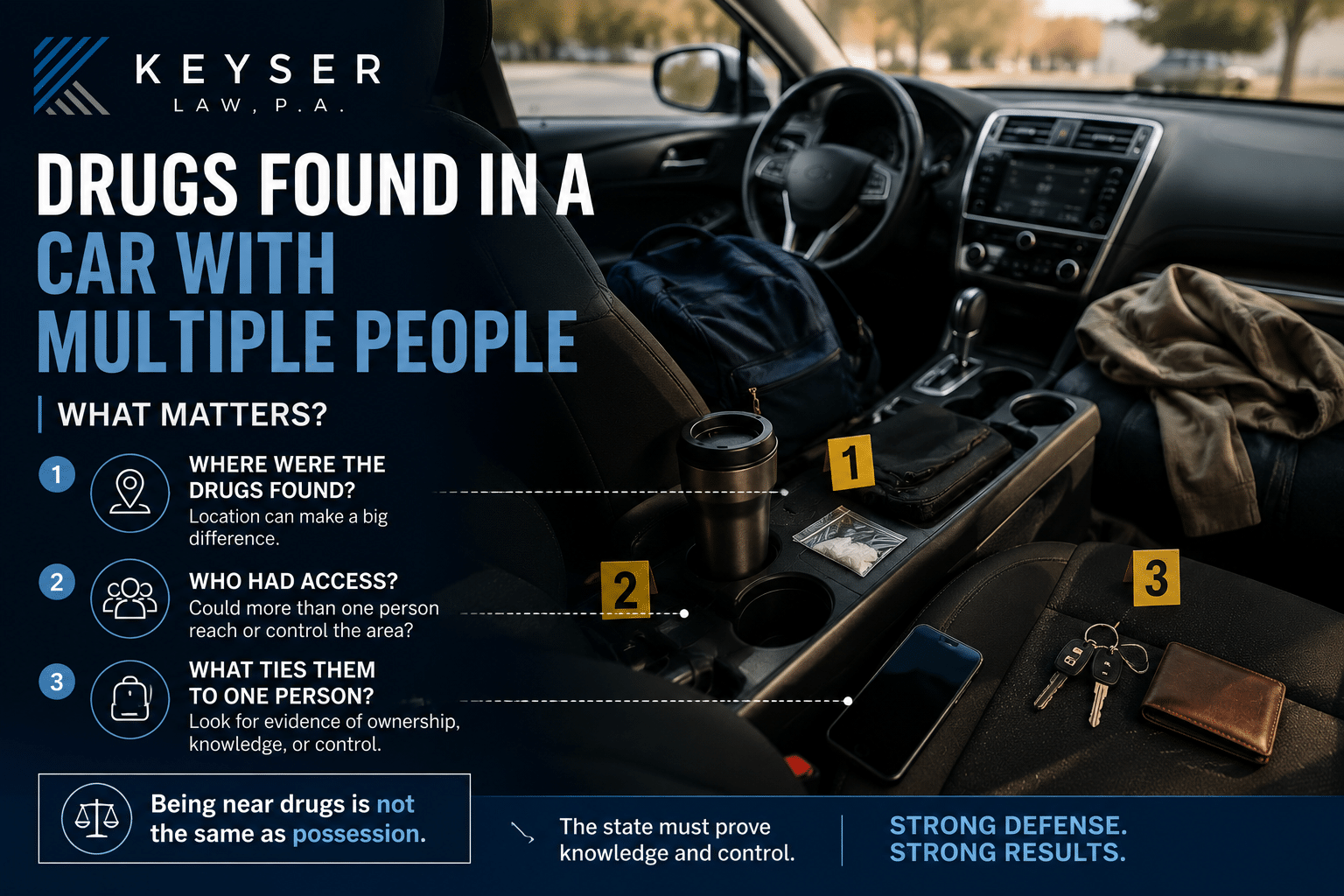
Drugs Found in a Car With Multiple People
Vehicle cases are common because police may find drugs in a glove compartment, center console, backpack, purse, door pocket, trunk, floorboard, or under a seat. When several people are in the car, police may question everyone and sometimes arrest more than one person.
Minnesota law does include a limited permissive inference for controlled substances found in passenger automobiles. In certain charged offenses, the presence of a controlled substance in a passenger automobile may permit a factfinder to infer knowing possession by the driver or person in control of the vehicle. But this inference is not automatic, and the statute includes exceptions.
That means the facts still matter. Who owned the car? Who was driving? Where were the drugs located? Were they hidden on another person? Did anyone admit possession? Were there fingerprints, messages, or other evidence tying the drugs to one person instead of another?
A passenger should not assume they are safe simply because they were not driving. A driver should not assume they are automatically guilty simply because drugs were found somewhere in the car.
Drugs Found in an Apartment, House, or Shared Room
Shared housing creates similar issues. Drugs may be found in a bedroom, bathroom, living room, closet, kitchen cabinet, nightstand, garage, or common area. A roommate, guest, partner, or family member may say the drugs belonged to someone else, but police may still look at who had access and control.
Important facts may include:
- Who lived at the property
- Who had keys or regular access
- Whose belongings were near the drugs
- Whether the drugs were in a private or common area
- Whether the drugs were hidden or in plain view
- How long the accused person had been at the location
- Whether the accused person made any statements about the substance
A guest who arrived shortly before police searched the residence is in a different position from someone whose private closet, drawer, or bag contained the substance. Those differences should be investigated before anyone assumes the charge is valid.
How Drug Possession Charges Are Graded in Minnesota
Minnesota drug possession charges can range from lower-level offenses to serious felonies depending on the substance, amount, alleged conduct, aggravating factors, and prior record. Many possession cases are charged under Minnesota’s fifth-degree controlled substance law, but the correct degree depends on the facts.
Under Minnesota Statutes § 152.025, fifth-degree possession can apply to unlawful possession of certain Schedule I, II, III, or IV controlled substances, subject to statutory exceptions. The statute also provides that some first-time possession cases involving very small amounts may be treated as gross misdemeanors, while other fifth-degree cases may carry felony-level exposure of up to five years in prison and a fine of up to $10,000.
Weight, packaging, mixture rules, and lab testing can also affect the charge. In some cases, prosecutors may argue that the amount, packaging, cash, messages, or other evidence shows intent to sell rather than simple possession. That can significantly increase the stakes.
Defense Issues in “Those Drugs Were Not Mine” Cases
When someone says the drugs belonged to another person, the defense should not stop there. The stronger question is whether the state can prove knowing possession beyond a reasonable doubt.
Defense issues may include:
- Whether the accused person knew the drugs were present
- Whether the accused person had control over the place where drugs were found
- Whether other people had equal or greater access
- Whether the drugs were hidden on another person or inside someone else’s belongings
- Whether police conducted a lawful search
- Whether statements were taken legally
- Whether the lab testing and weight calculations support the charged degree
- Whether prosecutors are relying on assumption instead of proof
Search and seizure issues can be especially important. If police unlawfully searched a vehicle, residence, bag, or container, you may be able to challenge the evidence. Statements made during the stop, arrest, or interrogation may also need to be reviewed.
What to Do If You Are Accused of Possessing Someone Else’s Drugs
If you are accused of drug possession after drugs were found in a shared space, be careful about explaining yourself to police. Even statements meant to help can be used against you later.
Write down what you remember as soon as you can. Note where the drugs were allegedly found, who else was present, who had access to the area, what officers said, whether anyone else claimed the drugs, and whether police searched a car, home, bag, or phone. Save messages or information that may show the drugs belonged to someone else or that you did not know they were there.
Then speak with a defense lawyer before making additional statements. A lawyer can review the evidence, request discovery, examine the search, and determine whether the state can actually prove possession.
Talk to a Minneapolis Drug Crime Lawyer About a Shared-Space Drug Charge
Being near drugs that belong to someone else can still lead to an arrest, but an arrest is not the same thing as proof. Minnesota prosecutors must still connect you to the substance through evidence of knowledge and control.
Christopher Keyser and the team at Keyser Law, P.A. defend people accused of drug possession and other controlled substance offenses in Minneapolis and throughout Minnesota. We look at where the drugs were found, who had access, whether the search was lawful, and whether the state can prove constructive possession.
If you were arrested after drugs were found in a car, apartment, house, or other shared space, contact Keyser Law, P.A. today for a confidential consultation.
Frequently Asked Questions About Drugs That Belong to Someone Else in Minnesota
Can I be charged with drug possession if the drugs were not mine?
Yes. Minnesota prosecutors do not always have to prove that you owned the drugs. They must prove possession, which can include constructive possession if they claim you knowingly exercised control over the substance.
Is being in the same car as drugs enough for a conviction?
Not by itself. The state still needs evidence connecting you to the drugs. The location of the drugs, who controlled the car, who had access, and whether the substance was hidden on another person can all matter.
Can more than one person possess the same drugs?
Yes. Minnesota law can allow possession to be shared. However, the state still has to prove the required connection between each accused person and the substance.
