




A Minnesota burglary charge may sometimes be reduced to trespassing when the evidence does not support the additional elements required for burglary. The most important difference is usually criminal intent: burglary requires proof that a person entered a building without consent and intended to commit a crime inside, or actually committed a crime after entering. Ordinary trespass does not require proof of that same criminal purpose.
That does not mean every weak burglary case automatically becomes trespassing. The facts still have to fit Minnesota’s trespass statute, and some burglary allegations involve circumstances that make a lesser charge unrealistic. But when the state’s proof of intent, consent, entry, or another burglary element is weak, a reduced charge can become a meaningful defense objective.
At Keyser Law, P.A., we examine what the prosecution can actually prove rather than accepting the charge label at face value. A Minneapolis burglary defense lawyer can review the entry, alleged intent, location, and surrounding evidence to determine whether the facts truly support burglary.
What Minnesota Must Prove for a Burglary Charge
Minnesota burglary law generally requires proof that a person entered a building without consent and either intended to commit a crime inside or actually committed a crime while inside. “Without consent” can include entering without permission, gaining entry through trick or misrepresentation, or remaining after consent has been withdrawn under the statute.
The degree of burglary depends on additional facts. First-degree burglary can involve an occupied dwelling, a dangerous weapon, or an assault. Second-degree burglary can involve dwellings, certain banks or pharmacies, possession of tools used to gain access to money or property, or certain protected buildings.
Third-degree burglary generally involves intent to steal or commit a felony or gross misdemeanor. Fourth-degree burglary generally involves intent to commit a non-theft misdemeanor.
Those distinctions matter because burglary can range from a gross misdemeanor to a serious felony carrying years of potential imprisonment.
Burglary vs. Trespassing in Minnesota
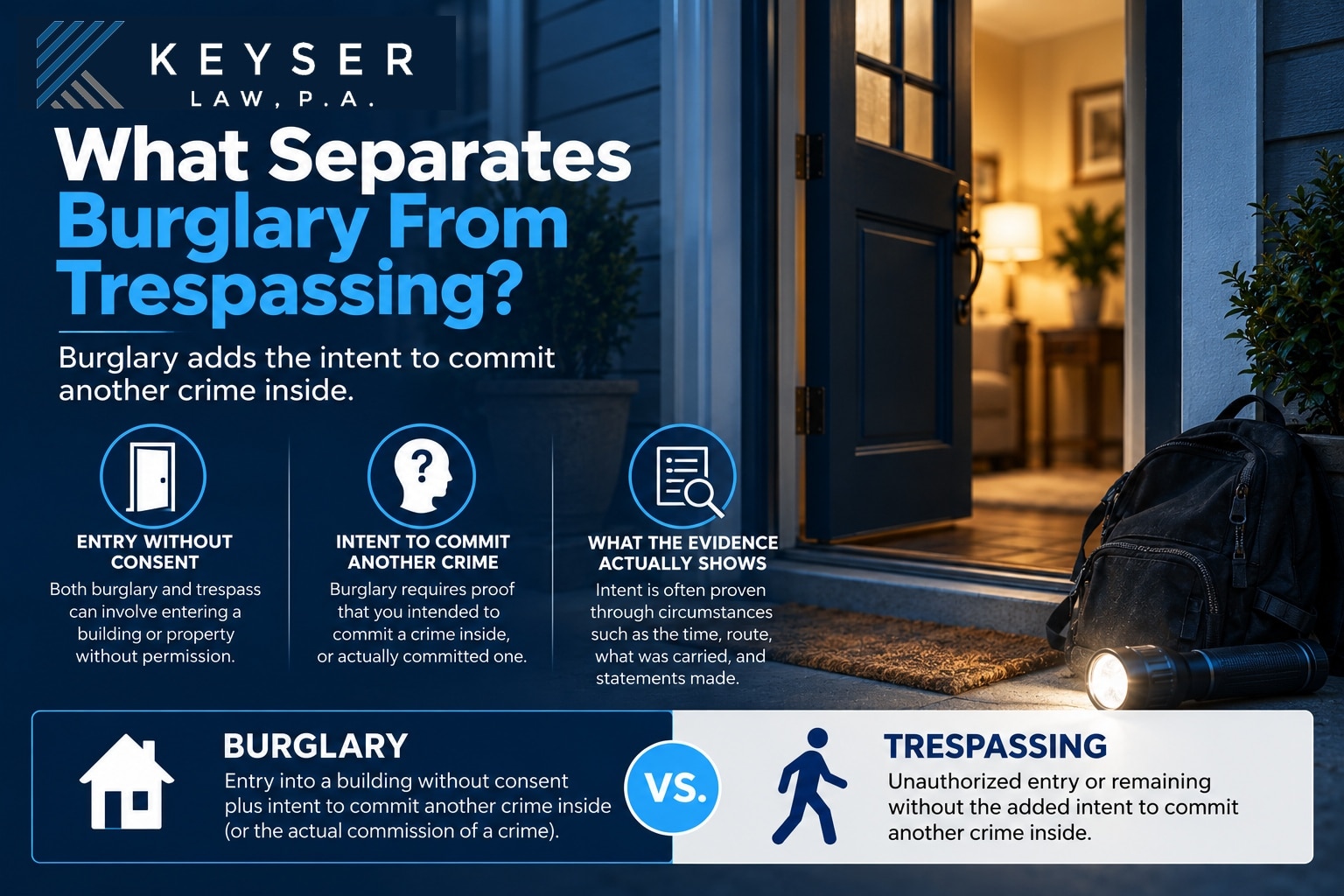
Burglary and trespass overlap in some situations, but they are not interchangeable offenses. Minnesota’s ordinary trespass statute covers several forms of unauthorized entry or remaining on property, including intentionally entering or occupying another person’s dwelling or locked or posted building without claim of right or consent, and refusing to leave another person’s premises after a lawful demand to depart.
What often separates a burglary case from a trespass case is the prosecution’s proof of what the person intended to do after entering. Trespass can be established by unauthorized entry or remaining under the circumstances the statute describes. Burglary adds the allegation that the person intended to commit, or actually committed, another crime inside the building.
Prosecutors often prove that intent through circumstantial evidence rather than a direct admission. Prosecutors may point to the time of entry, how the person entered, where the person went, what was carried, what was damaged or taken, statements made before or after entry, or other conduct inside the building.
What Are the Penalties for Burglary Compared With Trespassing?
The difference in potential exposure can be substantial.
- First-degree burglary: up to 20 years in prison and a fine of up to $35,000.
- Second-degree burglary: up to 10 years in prison and a fine of up to $20,000.
- Third-degree burglary: up to five years in prison and a fine of up to $10,000.
- Fourth-degree burglary: up to 364 days in jail and a fine of up to $3,000.
- Ordinary misdemeanor trespass: up to 90 days in jail and a fine of up to $1,000.
Some forms of trespass are classified as gross misdemeanors, so the exact subdivision matters. Felony burglary offenses also fall under Minnesota’s sentencing guidelines, where the offense’s severity and the person’s criminal history can affect the presumptive sentence.
When Can a Burglary Charge Be Reduced to Trespassing?
A reduction usually comes from a weakness in the state’s ability to prove burglary, not simply from asking for a lighter charge. Several issues can create room for a trespass resolution.
1. Weak Evidence of Criminal Intent
If the state cannot prove that the person intended to commit another crime inside the building, the burglary theory may weaken substantially. A case with no theft, no damage, no assault, no incriminating statements, and no other evidence of criminal purpose can present a very different issue from a case involving stolen property or burglary tools.
2. Disputes About Consent or Permission
Consent can be critical. Shared residences, prior invitations, relationships between the parties, access to a property, or a genuine dispute about whether permission had been withdrawn can affect the burglary analysis.
However, if the evidence shows valid consent to enter, that may also undermine an ordinary trespass charge. The defense must therefore evaluate both offenses separately rather than assuming trespass automatically applies whenever burglary is doubtful.
3. The Location May Not Qualify as a “Building” for Burglary
Minnesota defines a building for burglary purposes as a structure suitable for sheltering human beings, including certain connected or appurtenant structures. A yard, open lot, or other area may fall outside that definition even though unauthorized presence there could potentially support a different trespass theory.
4. Plea Negotiations Based on Proof Problems
Prosecutors may agree to amend a burglary charge when the evidence supporting one or more burglary elements is weak. A trespass resolution can sometimes reflect the conduct the state believes it can prove without requiring the defendant to admit the additional criminal intent alleged in the burglary count.
The viability of that outcome depends on the evidence, the charged degree, the person’s record, any related charges, and the prosecutor’s assessment of the case.
What Evidence Matters Most in a Burglary-to-Trespass Defense?
Because intent is often inferred, even small facts can matter. A defense lawyer may examine:
- Whether there was forced entry
- Whether the person had previously been invited or given access
- Whether anything was taken or damaged
- Whether burglary tools or weapons were present
- Where the person went after entering
- Text messages, calls, or other communications about the property
- Surveillance footage or witness statements
- Statements made to police
- Whether another charged offense actually occurred inside
The question is not simply whether the person was somewhere without permission. The burglary charge depends on the state proving the additional element or conduct required by the particular burglary statute.
Can a Burglary Reduction Affect Firearm Rights?
Potentially. Minnesota’s firearm statutes classify first- and second-degree burglary as “crimes of violence.” A felony conviction for one of those offenses can therefore trigger serious firearm consequences under Minnesota law.
Trespass is not included in that crime-of-violence definition. That means reducing a first- or second-degree burglary charge to trespass can have consequences beyond immediate jail or prison exposure, although firearm eligibility always depends on the person’s complete record and any other state or federal disqualification.
Can a Reduced Charge Affect Expungement Eligibility?
Yes, but the analysis is more specific than simply comparing “felony” with “misdemeanor.” Minnesota’s expungement statutes use different eligibility rules and waiting periods depending on the offense and disposition.
For qualifying convictions, the current waiting periods generally include two years after discharge for a misdemeanor, three years for a gross misdemeanor, and five years for most qualifying felonies. Certain dispositions, including qualifying diversion programs and stays of adjudication, can follow different rules.
Not every burglary conviction qualifies for the same form of expungement relief, so the specific offense matters. A reduced trespass conviction may create a different and potentially more favorable record-relief path than a felony burglary conviction.
Does a Reduction to Trespassing Mean the Case Was Dismissed?
No. A reduced charge and a dismissal are different outcomes.
If a burglary charge is amended to trespass and the person pleads guilty or is convicted of trespass, there is still a criminal conviction unless the case is resolved through a different disposition such as a stay of adjudication or another qualifying agreement.
The benefit of a reduction can still be substantial because the offense level, maximum penalties, sentencing consequences, collateral consequences, and future record-relief options may all change.
Talk to a Minneapolis Burglary Defense Lawyer About the Intent Evidence
A burglary charge can look much more serious than the conduct the state can ultimately prove. The central question is whether the evidence establishes every element of burglary, especially criminal intent and the circumstances surrounding the entry.
Christopher Keyser and the team at Keyser Law, P.A. defend burglary and other serious criminal charges throughout Minneapolis and Minnesota. We examine consent, entry, intent, related offenses, statements, surveillance, and other evidence before determining whether the burglary charge can be challenged, dismissed, or negotiated to a lesser offense.
If you are facing a burglary allegation and believe the state is overstating what happened, contact Keyser Law, P.A. for a confidential consultation.
Frequently Asked Questions About Reducing Burglary to Trespassing in Minnesota
Can burglary be reduced to trespassing if nothing was stolen?
Possibly, but the fact that nothing was stolen does not automatically eliminate burglary. Minnesota burglary can be based on intent to commit a crime inside even if that crime was never completed. The lack of theft or other criminal conduct may still make the state’s intent evidence harder to prove.
Is trespassing always a misdemeanor in Minnesota?
No. Many ordinary trespass offenses are misdemeanors, but Minnesota law classifies some types of trespass as gross misdemeanors. The location and circumstances determine which subdivision applies.
Does trespassing require proof that I intended to commit another crime inside?
No. Ordinary trespass does not require the same proof of intent to commit another crime that burglary requires. That distinction is one reason intent evidence can be central to negotiations over a burglary charge.
Can first- or second-degree burglary affect firearm rights in Minnesota?
Yes. Minnesota law includes first- and second-degree burglary in its statutory definition of a crime of violence, which can trigger firearm restrictions after a felony conviction.
