




Not always, and not always permanently. A felony conviction can make firearm or ammunition possession unlawful in Minnesota, but the duration and severity of the prohibition depend heavily on the conviction. Minnesota treats felony “crimes of violence” especially strictly: those convictions can create a lifetime state-law ban on possessing firearms or ammunition unless firearm rights are later restored by a court.
Other felony convictions can involve a different analysis, including whether the sentence has been discharged, civil rights have been restored, and whether any separate state or federal disqualification still applies. That is why a person should not assume that a past felony either permanently bars firearm possession or automatically stops mattering once probation ends.
At Keyser Law, P.A., we start by identifying the exact prior conviction and the law that applies. If you are being investigated or charged with possessing a gun or ammunition after a prior conviction, a Minneapolis weapons charges lawyer can review both the old case and the new possession allegation.
What Minnesota Means by a “Crime of Violence”
For firearm-disqualification purposes, “crime of violence” is a defined statutory term. It does not simply mean that the prior offense involved physical violence. Minnesota Statutes § 624.712 lists specific felony convictions that fall within the definition.
The list includes, among other offenses, felony assault and domestic assault offenses, robbery, carjacking, kidnapping, certain burglary offenses, arson, criminal sexual conduct, theft involving certain property, and felony controlled-substance offenses. Because the definition is statutory, a conviction that did not involve anyone being physically injured can still trigger the lifetime firearm prohibition.
That is especially important in older cases. A person may remember the facts of the prior offense but not know whether the specific conviction falls within Minnesota’s firearm-law definition of a crime of violence.
How Long Can a Firearm Ban Last After a Minnesota Felony?
The answer depends on the conviction and any other disqualifying circumstances.
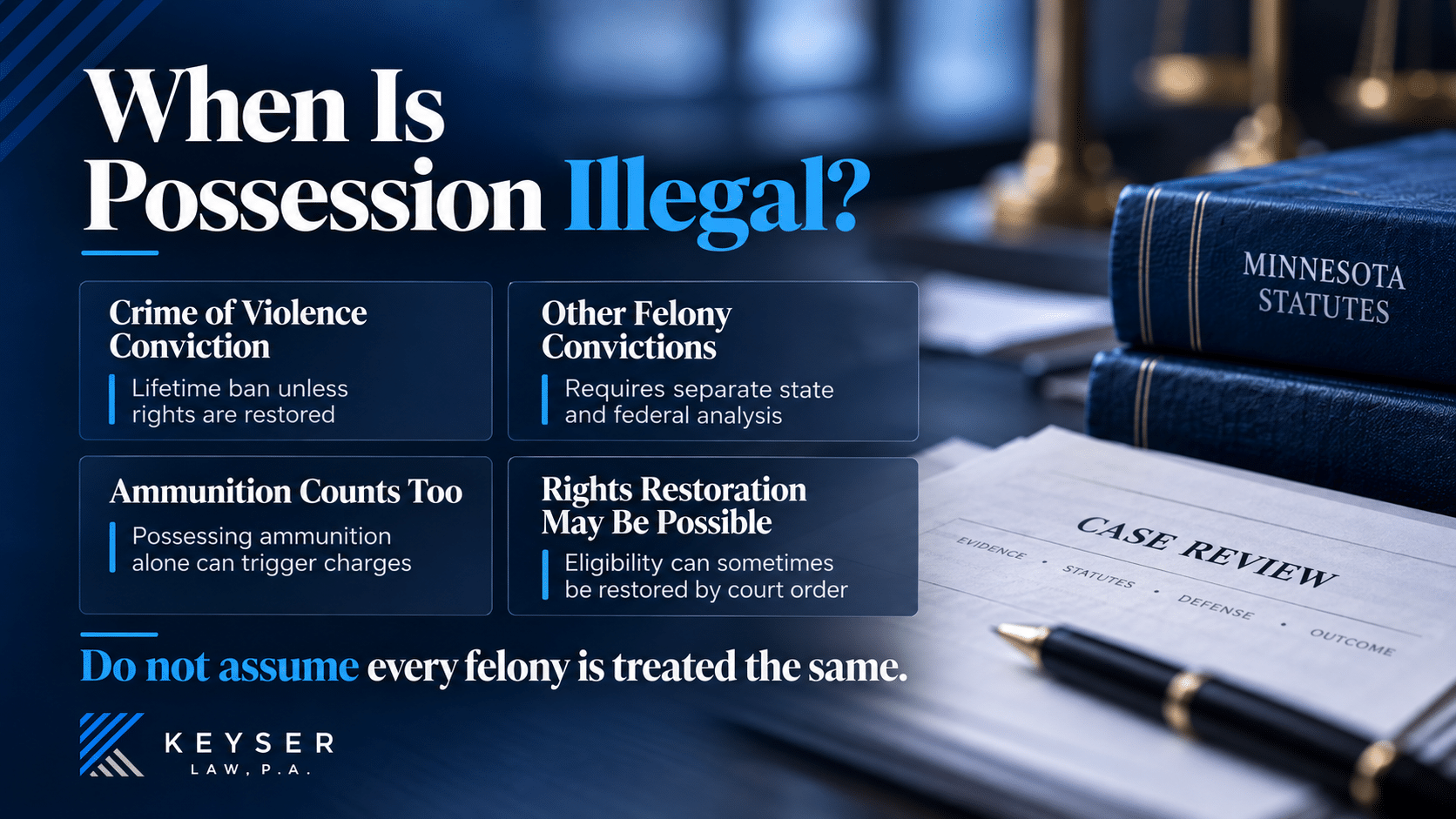
- Felony crime of violence: Minnesota law generally imposes a lifetime prohibition on possessing, receiving, shipping, or transporting firearms and ammunition unless rights are restored.
- Other felony convictions: firearm eligibility requires a separate analysis of the conviction, sentence discharge, restoration of civil rights, and any remaining state or federal prohibition.
- Certain misdemeanor and gross-misdemeanor offenses: Minnesota law can impose time-limited firearm restrictions for some drug, domestic-assault, harassment, and other qualifying convictions.
- Other disqualifications: protective orders, extreme risk protection orders, certain mental-health commitments, fugitive status, and other categories can independently affect firearm eligibility.
The key point is that there is no safe one-size-fits-all answer based only on the word “felony.” The exact conviction statute, the date of the case, whether the sentence was discharged, and whether rights were restored all matter.
Does the Minnesota Firearm Ban Include Ammunition?
Yes. Minnesota’s firearm-disqualification statutes apply to ammunition as well as firearms in several prohibited-person categories, including people convicted of a crime of violence.
That means a case does not necessarily require police to find a gun. Ammunition alone can create serious legal exposure if the person is prohibited from possessing it.
For someone with an old felony conviction, this detail matters. A box of ammunition left in a vehicle, closet, garage, or shared residence can create the same threshold question as a firearm: was the person legally prohibited, and can the state prove knowing possession?
What Are the Penalties for Firearm Possession by an Ineligible Person?
A person prohibited because of a felony crime of violence who possesses a firearm or ammunition can face a felony punishable by up to 15 years in prison and a fine of up to $30,000 under Minnesota Statutes § 624.713.
Minnesota law also imposes a five-year mandatory minimum prison term for a conviction under the crime-of-violence firearm-possession provision, subject to the limited circumstances in which a court may lawfully depart.
Other prohibited-person categories can carry different penalties. Under § 624.713, a person who falls within another listed disqualification category may face a gross misdemeanor for unlawful possession. That distinction is another reason the underlying disqualification must be identified correctly before evaluating the new charge.
Why Constructive Possession Matters in Minnesota Gun Cases
Many prohibited-person firearm cases do not involve a gun found in the accused person’s hand, waistband, or pocket. Instead, the firearm may be found in a shared vehicle, apartment, bedroom, closet, bag, garage, or another location accessible to more than one person.
In those cases, prosecutors may rely on constructive possession. The state may try to prove that the firearm was found in a place under the person’s exclusive control or that the surrounding circumstances create a strong probability that the person consciously exercised dominion and control over it.
Ownership is not necessarily the controlling question. A firearm may belong to a roommate, friend, spouse, passenger, or family member and still become the basis of a criminal charge if prosecutors believe the prohibited person knowingly possessed or controlled it.
Important facts can include:
- Where the firearm or ammunition was found
- Who owned or controlled the vehicle or residence
- Who had keys or access to the area
- Whether the firearm was inside another person’s belongings
- Whose personal property was near the firearm
- Whether anyone made statements about ownership or access
- Whether fingerprints, DNA, messages, photographs, or other evidence connect the person to the firearm
Being near a firearm is not automatically the same as possessing it. The state must still prove the required connection between the accused person and the weapon or ammunition.
Can Firearm Rights Be Restored After a Minnesota Crime-of-Violence Conviction?
Yes, in some cases. Minnesota Statutes § 609.165 allows a person prohibited because of a crime-of-violence conviction or qualifying delinquency adjudication to petition a district court for restoration of firearm and ammunition rights.
The person must be released from physical confinement, and the court may grant restoration if the person shows good cause. If the court denies the petition, you generally cannot file another for three years unless it allows you to file sooner.
The Minnesota Judicial Branch publishes forms specifically for petitions seeking restoration after a crime-of-violence conviction. The process is separate from ordinary criminal-record expungement.
Does Expungement Automatically Restore Gun Rights in Minnesota?
No. Expungement and firearm-rights restoration are separate legal issues.
The Minnesota Judicial Branch specifically warns that sealing a criminal record does not automatically restore the right to possess firearms or ammunition. A person whose rights were permanently removed because of a crime-of-violence conviction must address firearm restoration separately.
A pardon or other post-conviction relief may affect firearm eligibility in some circumstances, but the effect depends on the particular conviction and the scope of the relief granted.
How Federal Firearm Law Can Affect a Minnesota Felony Conviction
Federal law adds another layer. Under 18 U.S.C. § 922(g)(1), federal law generally prohibits firearm or ammunition possession by a person convicted of a crime punishable by more than one year in prison.
However, federal law also looks to the law of the jurisdiction where the conviction occurred when determining whether a conviction still counts for this purpose. Under 18 U.S.C. § 921(a)(20), a conviction that has been pardoned, set aside, expunged, or followed by restoration of civil rights may no longer count as a disqualifying conviction in some circumstances, unless the relief still expressly restricts firearm possession.
Because state and federal rules interact, someone with a prior Minnesota felony should not rely on a general statement that their rights are “back” without checking both systems.
What to Do If Police Find a Gun or Ammunition Near You
If you have a prior felony and police find a firearm or ammunition in a place you occupy, avoid guessing about whether you are legally eligible or trying to explain ownership on the spot.
Write down where officers say the firearm or ammunition was found, who else had access to the location, whose belongings were nearby, and what statements were made. Preserve messages, photographs, lease records, vehicle information, or other evidence that may help show who actually controlled the firearm.
The defense should then examine two separate questions: whether you were legally prohibited from possessing the firearm or ammunition and whether the state can prove that you actually or constructively possessed it.
Talk to a Minneapolis Weapons Charges Lawyer About a Felon-in-Possession Case
Firearm-possession cases involving prior convictions can carry severe consequences, especially when the old conviction qualifies as a Minnesota crime of violence. But a past felony is only one part of the analysis. The prosecution must still prove the applicable disqualification and the new act of possession.
Christopher Keyser is an MSBA Certified Criminal Law Specialist and represents clients facing serious Minnesota weapons and felony charges. Keyser Law, P.A. reviews the prior conviction, the firearm-disqualification rules, how police found the weapon or ammunition, and whether the evidence actually proves possession.
If you are facing a firearm charge after a prior felony conviction, contact Keyser Law, P.A. for a confidential consultation.
Frequently Asked Questions About Felons and Firearm Possession in Minnesota
Is every Minnesota felony a lifetime firearm ban?
No. Minnesota’s lifetime state-law prohibition applies specifically to felony convictions that fall within the statutory definition of a crime of violence. Other felony convictions require a separate review of sentence discharge, civil-rights restoration, and any remaining state or federal restrictions.
Can a person prohibited from possessing firearms also be charged for possessing ammunition?
Yes. Minnesota law prohibits ammunition possession for people in several prohibited-person categories, including those convicted of a crime of violence. A firearm does not necessarily have to be found for a prohibited-person charge involving ammunition.
Can gun rights be restored after a crime-of-violence conviction in Minnesota?
Potentially. Minnesota law allows an eligible person to petition a district court to restore firearm and ammunition rights after release from physical confinement. The court may grant the petition if the person shows good cause.
Does expunging a felony automatically restore firearm rights?
No. Minnesota courts state that expungement does not automatically restore firearm or ammunition rights. Firearm restoration is a separate legal process.
