



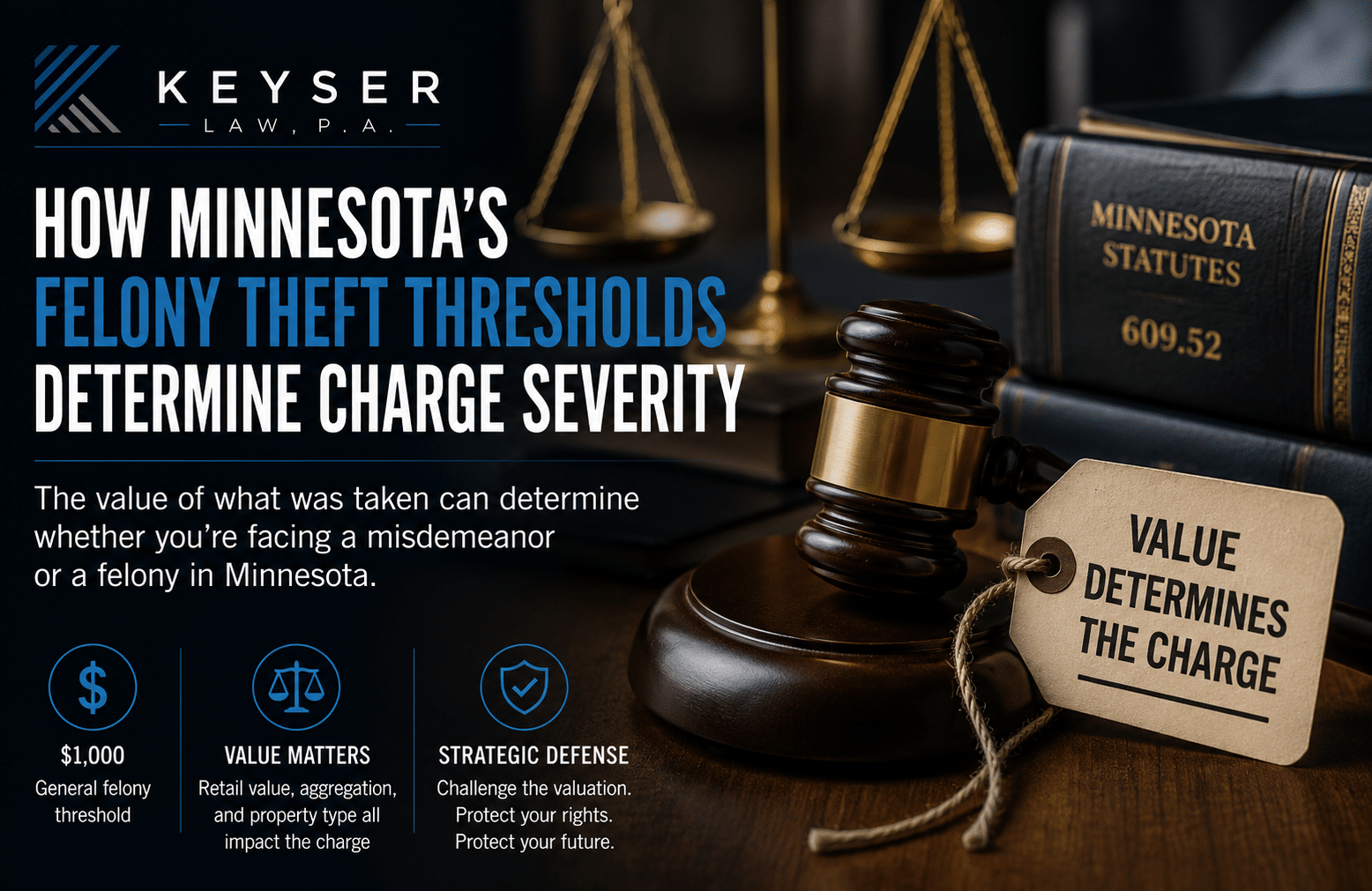
In Minnesota, the value of the property or services involved in a theft allegation can determine whether the case is charged as a misdemeanor, gross misdemeanor, or felony. For many ordinary theft offenses, the general felony threshold is more than $1,000. But value is not the only factor. Certain types of property, prior qualifying convictions, aggregation of multiple thefts, and circumstances that create a risk of bodily harm can increase the charge even when the amount is lower.
That is why the number written in a police report or charging document deserves careful review. At Keyser Law, P.A., we examine how prosecutors calculated the alleged value, whether the correct statutory threshold applies, and whether the facts actually support the level of theft charged. A Minneapolis theft defense lawyer can challenge both the valuation and the legal basis for a felony-level charge.
What Dollar Amount Makes Theft a Felony in Minnesota?
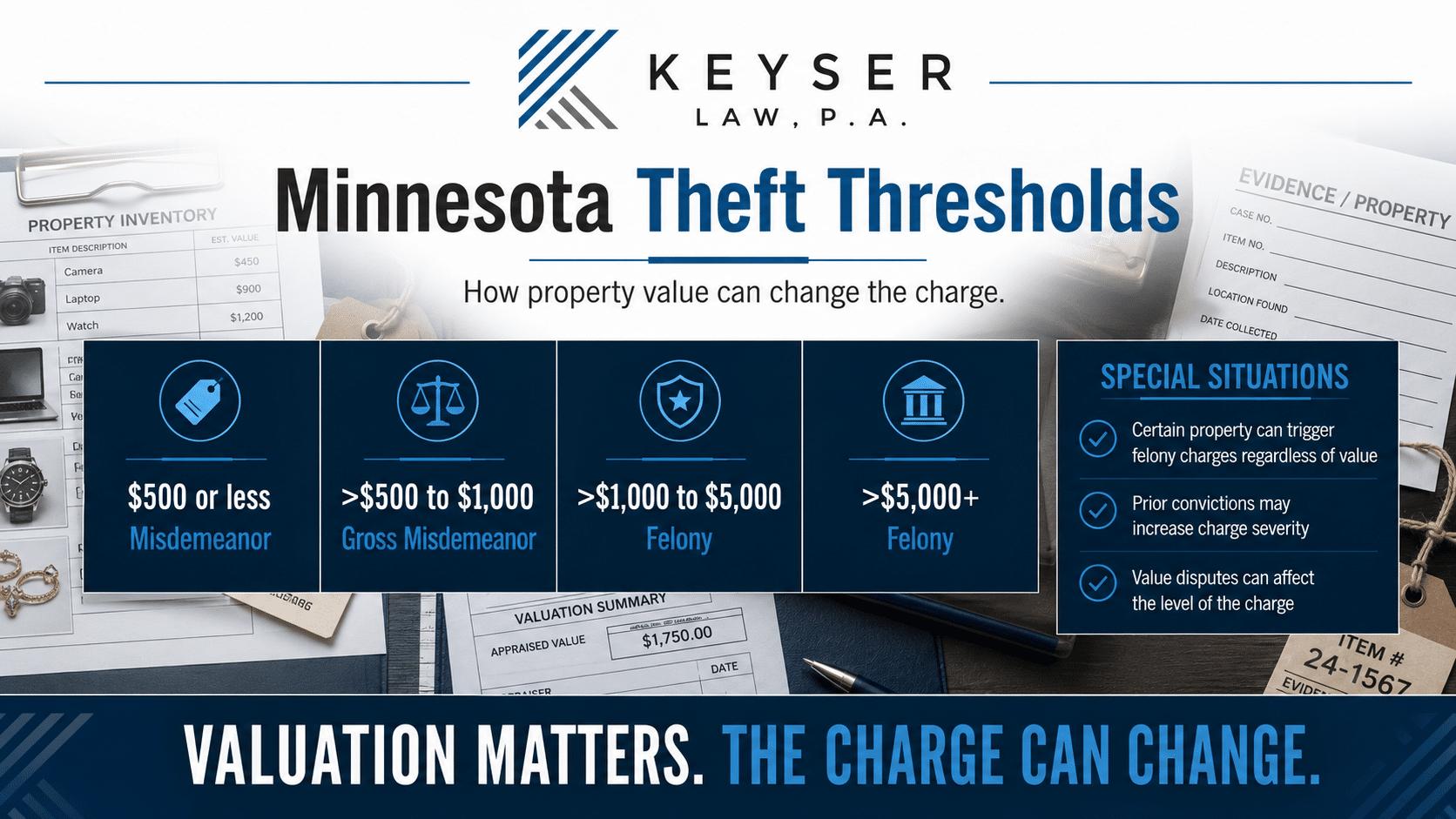
Under Minnesota Statutes § 609.52, the basic theft thresholds are generally:
- $500 or less: misdemeanor, punishable by up to 90 days in jail and a fine of up to $1,000.
- More than $500 but not more than $1,000: gross misdemeanor, punishable by up to 364 days in jail and a fine of up to $3,000.
- More than $1,000 but not more than $5,000: felony, punishable by up to five years in prison and a fine of up to $10,000.
- More than $5,000: felony, punishable by up to ten years in prison and a fine of up to $20,000.
The highest penalty tier can apply to theft of a firearm regardless of value. It can also apply when the value exceeds $35,000, and the conviction involves certain theft-by-swindle, false-representation, diversion, wage-theft, or related offenses covered by the statute.
One important exception affects lower-value theft allegations. Property valued at more than $500 but not more than $1,000 can be charged at the five-year felony level if the accused has a qualifying prior conviction within the preceding five years and the prior case resulted in a felony or gross-misdemeanor sentence, or a qualifying stayed sentence.
How Minnesota Determines the Value of Allegedly Stolen Property
Minnesota law generally defines “value” as the retail market value of the property or services at the time of the theft. If that value cannot be established, the statute allows replacement cost within a reasonable time after the theft.
That can make valuation more complicated than simply looking at a receipt or asking what the owner originally paid. Age, condition, retail market evidence, replacement pricing, and the nature of the item may all become relevant. When the alleged value is close to $500, $1,000, or $5,000, even a relatively small valuation dispute can change the offense level.
For the defense, that means asking where the number came from. Did the state use an actual retail value? A replacement estimate? A store’s listed price? An owner’s estimate? Was depreciation or condition considered where relevant? A valuation should be supported by evidence, not simply repeated because it appeared in the initial report.
Can Multiple Smaller Thefts Be Added Together?
Yes, in certain cases. Minnesota’s theft statute allows amounts from multiple qualifying thefts committed within a six-month period to be aggregated and charged according to the combined value.
That means several allegations that might individually fall below the felony threshold can sometimes be combined into a larger case. For example, a series of qualifying alleged thefts may be treated differently from one isolated incident if the statute permits aggregation and the state can prove the required connection between them.
Aggregation should not be assumed to apply automatically. The defense should examine whether the allegations fall within the statutory provisions that permit aggregation, whether the incidents occurred within the required time period, and whether the state can prove the accused committed each alleged act.
Which Minnesota Thefts Can Be Felonies Regardless of Value?
Some Minnesota theft offenses can carry felony exposure even when the property is worth $1,000 or less. Under § 609.52, the five-year felony tier can apply when the property is:
- Taken from the person of another, or from a corpse, grave, or coffin containing a corpse
- A court record or another record or document legally kept or filed with a public office
- Taken from a burning, abandoned, or vacant building, or from an area affected by certain disasters or civil unrest
- Public funds belonging to the state or a political subdivision or agency
- A motor vehicle
Other property categories can trigger even higher felony exposure without relying on ordinary dollar thresholds. Theft of a firearm falls within the statute’s highest penalty tier. Theft of certain controlled substances, trade secrets, and explosive or incendiary devices can also carry felony-level penalties regardless of ordinary market value.
This is why asking only “How much was it worth?” does not always answer the charge-severity question. The type of property and how the theft is alleged to have occurred can matter as much as price.
Can Risk of Bodily Harm Increase a Minnesota Theft Charge?
Yes. Minnesota law contains an enhancement when a theft creates a reasonably foreseeable risk of bodily harm to another person. If the underlying theft would otherwise be a misdemeanor or gross misdemeanor, the enhancement can elevate the offense to a felony. If the underlying theft is already a felony, the statutory maximum sentence can increase by 50%.
Whether that enhancement applies is a fact-specific question. The prosecution must still prove the circumstances supporting the increased exposure rather than simply relying on the value of the property.
Does a Minnesota Felony Theft Charge Mean You Will Go to Prison?
No. The maximum sentence listed in the theft statute is not the same thing as the sentence a court is presumed to impose in every case.
Minnesota uses sentencing guidelines that consider the severity level assigned to the conviction offense and the person’s criminal history score. Theft offenses can fall at different severity levels depending on the amount and the specific statutory provision involved. For example, ordinary theft of $5,000 or less is generally treated differently under the guidelines from theft over $5,000, while theft from a person, theft of a firearm, motor-vehicle theft, and other specially classified theft offenses may be ranked differently.
The applicable guidelines in effect on the date of the offense matter, as do criminal history, aggravating or mitigating circumstances, plea negotiations, and the precise offense of conviction. A felony charge therefore does not automatically tell you whether the likely result is probation, a stayed sentence, local jail, or prison.
How a Theft Defense Lawyer Can Challenge the Charge Level
When the prosecution’s theory depends on a dollar threshold, the defense should examine the valuation before treating the charge level as fixed. Issues may include:
- Whether the state used the correct retail market value
- Whether replacement cost was properly used
- Whether the property’s age or condition affects the valuation evidence
- Whether multiple incidents can legally be aggregated
- Whether a prior conviction actually qualifies for an enhancement
- Whether the property type triggers a special felony provision
- Whether a bodily-harm enhancement is supported by the facts
- Whether the sentencing guidelines match the offense actually charged or ultimately resolved
These issues matter most when the alleged value is close to a statutory line. Moving a valuation below $1,000 or $5,000 can materially change the maximum exposure and may also affect plea negotiations and sentencing.

Talk to a Minneapolis Theft Defense Lawyer About the Valuation
A theft charge is not simply about whether property was allegedly taken. The prosecution must also prove the facts that determine how serious the offense is. In many Minnesota cases, that means proving a particular value, a qualifying property type, a prior conviction, or another enhancement beyond the basic theft allegation.
Christopher Keyser and the team at Keyser Law, P.A. defend clients facing misdemeanor, gross-misdemeanor, and felony theft allegations throughout Minneapolis and Minnesota. We review how the state valued the property, whether the right threshold applies, and whether the evidence supports the level of charge being pursued.
If you are facing a theft charge and the alleged value is affecting the severity of the case, contact Keyser Law, P.A. for a confidential consultation.
Frequently Asked Questions About Minnesota Felony Theft Thresholds
What is the general felony theft threshold in Minnesota?
For many ordinary theft offenses, property or services valued at more than $1,000 can be charged as felony theft. However, certain property types and enhancements can create felony exposure even when the value is $1,000 or less.
Can theft under $1,000 ever be a felony in Minnesota?
Yes. Theft involving certain property, including a motor vehicle or property taken from another person, can be a felony regardless of ordinary value thresholds. A qualifying prior conviction can also elevate some thefts valued at more than $500 but not more than $1,000.
Can prosecutors combine several smaller thefts to reach the felony threshold?
In certain qualifying theft cases, Minnesota law allows amounts received within a six-month period to be aggregated. Whether aggregation is permitted depends on the specific theft allegations and statutory provision involved.
Does being charged with felony theft mean I will go to prison?
No. The statutory maximum is not an automatic sentence. Minnesota sentencing guidelines, criminal history, the offense of conviction, and the facts of the case all affect the likely sentencing range and whether prison is presumptive.
