



Probation and parole are often discussed together, but they do not mean the same thing in Minnesota. The main difference is when supervision happens. Probation is usually ordered by a judge instead of sending someone to prison, while parole or supervised release generally happens after someone has served part of a prison sentence.
That difference matters. The rules, supervising authority, violation process, and possible consequences are not always the same. A person on probation may be sent back to the sentencing judge if they violate the terms of probation. A person on supervised release may instead deal with the Minnesota Department of Corrections and possible return to prison.
At Keyser Law P.A., we represent clients throughout Minneapolis and Minnesota who are facing criminal charges, sentencing issues, probation violations, and post-conviction supervision concerns. Understanding the difference between probation and parole can help you better understand your rights, your obligations, and the risks involved.
What Is Probation in Minnesota?
Probation allows a convicted person to serve all or part of a sentence under supervision in the community instead of serving the sentence in jail or prison. In many cases in Minnesota, probation is part of a stayed sentence. This means the judge may impose or pronounce a sentence, but stay execution of that sentence while the person follows probation conditions.
Probation may be ordered in misdemeanor, gross misdemeanor, and felony cases. The sentencing judge sets the terms, and those conditions vary depending on the offense, criminal history, risk level, and facts of the case.
Common probation conditions may include:
- Reporting to a probation officer
- Remaining law-abiding
- Avoiding alcohol or controlled substances
- Submitting to random testing
- Completing community service
- Attending treatment, counseling, or educational programming
- Maintaining employment or schooling
- Avoiding contact with alleged victims, witnesses, or co-defendants
- Following geographic, travel, or residence restrictions
The length of probation varies. Some misdemeanor probation terms may last one or two years. Felony probation can last longer, depending on the offense and sentence. In Minnesota, probation is often supervised at the county level, although some cases may be handled by the Minnesota Department of Corrections.
What Is Parole or Supervised Release in Minnesota?
Parole in Minnesota is different from the traditional parole system many people imagine. Minnesota largely moved away from discretionary parole for most felony offenses after sentencing guideline reforms. In many cases, the more accurate term is supervised release.
Supervised release generally occurs after a person has served the prison portion of an executed sentence. The person is released from prison but remains under supervision for a set period. The Minnesota Department of Corrections oversees supervised release.
Conditions of supervised release may include:
- Reporting to a corrections agent
- Following residential restrictions
- Avoiding certain people, places, or activities
- Completing treatment or programming
- Submitting to drug or alcohol testing
- Complying with electronic monitoring when ordered
- Following release plans and supervision instructions
Some cases may also involve conditional release. For certain sex offenses, Minnesota law can require a separate conditional release term after imprisonment, which may last many years and, in some cases, can be much longer than ordinary supervision.
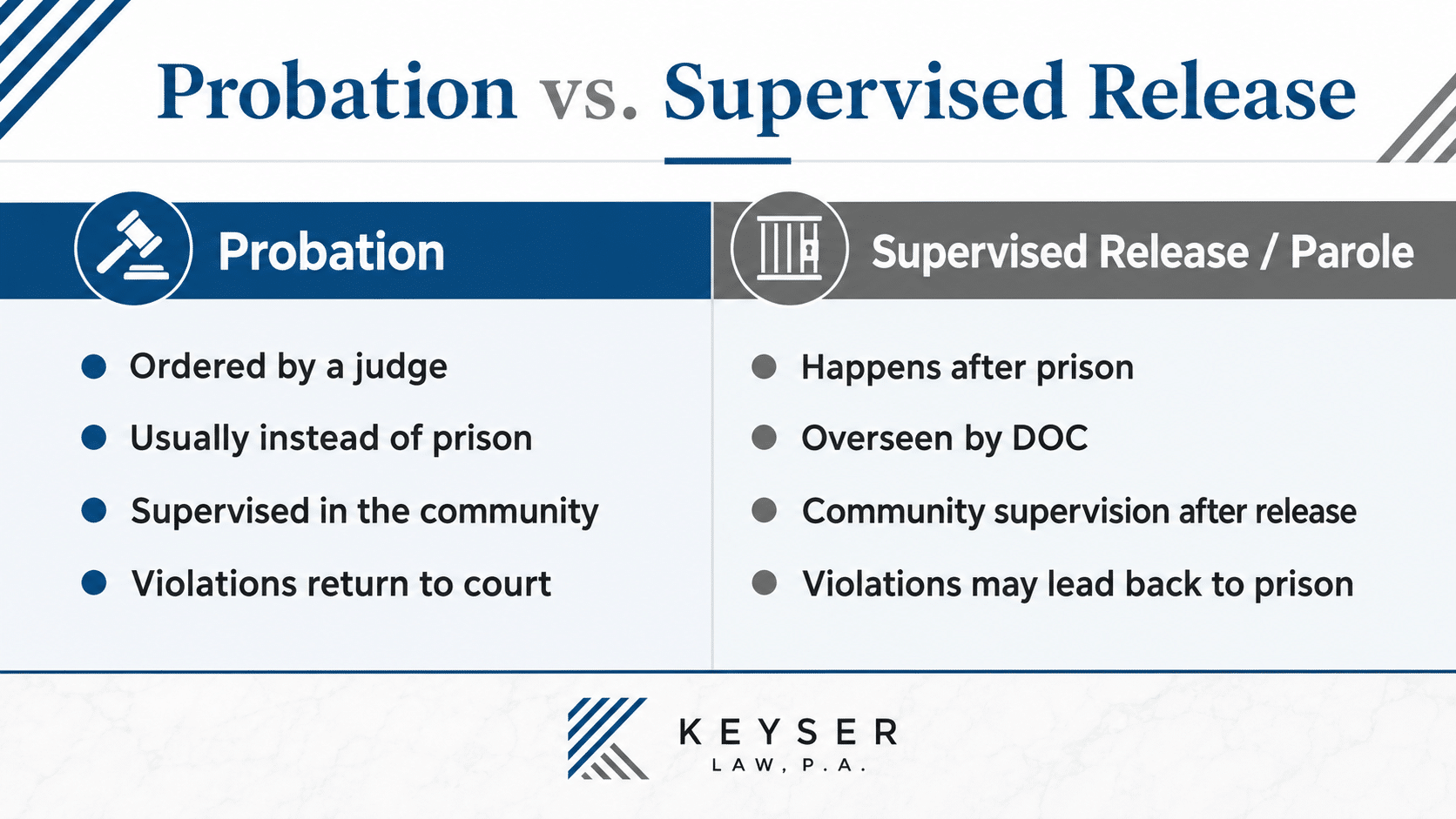
Probation vs. Parole in Minnesota: The Key Difference
The most important difference between probation and parole is timing.
Probation usually happens instead of prison. It is ordered by the court at sentencing and allows a person to remain in the community under supervision if they follow the court’s conditions.
Supervised release happens after prison. It applies after someone has served the prison portion of an executed sentence and is released into the community under Department of Corrections supervision.
There are also important differences in who controls the process. Probation is tied to the sentencing court and often the county probation department. Supervised release is generally controlled by the Minnesota Department of Corrections.
What Happens If You Violate Probation?
A probation violation can lead to serious consequences, including jail or prison. In Minnesota, probation violations are usually handled by the court. The probation officer may file a violation report, and the person accused of violating probation may be required to appear before a judge.
Under Minnesota Statutes § 609.14, probation revocation involves court procedures and findings. The judge may consider whether a violation occurred, whether the violation was intentional or inexcusable, and what response is appropriate. Revocation is not supposed to be automatic in every case. The court may modify probation, add new conditions, order jail time, or revoke the stayed sentence.
For someone accused of violating probation, the details matter. A missed appointment, a failed test, a new arrest, a failure to complete treatment, or a contact violation can all raise different legal and factual issues. If you are facing this situation, a Minnesota probation violation lawyer can help you understand the allegation, prepare for the hearing, and argue for an outcome that protects your freedom.
What Happens If You Violate Supervised Release?
A supervised release violation is handled differently from a probation violation. Because supervised release follows a prison sentence, the Minnesota Department of Corrections has a central role in responding to alleged violations.
If a person violates supervised release conditions, they may face sanctions, increased restrictions, or revocation. In serious cases, the person may be returned to prison to serve additional time. The process is not the same as appearing before the original sentencing judge for a probation violation.
This is one reason it is important not to use probation, parole, supervised release, and conditional release as if they all mean the same thing. Each form of supervision has its own legal structure and potential consequences.
Why the Difference Matters
The difference between probation and parole matters because it affects who supervises you, what rules apply, how violations are handled, and what penalties may follow. It can also affect defense strategy before sentencing.
For example, a person facing sentencing may be trying to avoid an executed prison sentence and obtain probation instead. A person already on probation may need help responding to an alleged violation. A person released from prison may need to understand the conditions of supervised release and the risks of revocation.
In each situation, the legal goal may be different. The defense may involve arguing for probation, challenging a violation, modifying supervision conditions, presenting treatment or employment progress, or contesting a return to custody. These issues can arise in many types of criminal cases, including felony matters, probation violation cases, and some Minnesota DWI defense matters where sentencing and supervision conditions are part of the case.
Talk to a Minnesota Criminal Defense Attorney
Probation, parole, supervised release, and conditional release can be confusing, especially when your freedom is at stake. The label matters, but so do the facts of your case, the original sentence, the conditions imposed, and the authority supervising you.
At Keyser Law P.A., Christopher Keyser and his team help clients throughout Minneapolis and Minnesota understand their options before sentencing, during probation, and when alleged violations arise. Whether you are facing criminal charges, trying to avoid prison, accused of violating probation, or dealing with supervised release issues, our team can help you evaluate the risks and build a strategy.
Contact Keyser Law P.A. today for a confidential consultation with a Minneapolis criminal defense attorney.
