



In Minnesota, borrowing something and failing to return it does not always remain a simple misunderstanding between two people. Depending on the facts, it can raise questions that sit somewhere between civil disagreement and criminal liability, especially when the item has value or the original owner believes it was intentionally kept.
Minnesota theft laws are not limited to breaking into property or taking items by force. In certain situations, you can be charged with theft for continued possession of someone else’s property despite a clear expectation of return. This is particularly true if there is evidence suggesting the item was meant to be temporary in your control.
This issue often leaves people unsure where the line is drawn between a private dispute and a criminal allegation. At Keyser Law P.A., we can address concerns in that gray area.
When Can You Be Charged With Theft Under Minnesota Law?
Under Minnesota law, theft is defined broadly and is not limited to situations in which someone physically takes property from another person. The controlling statute is Minnesota Statutes § 609.52, which covers a range of conduct involving the unauthorized taking, use, or retention of another person’s property.
At its core, the law focuses on two key ideas, namely control over property and intent. A person may be charged with theft if, without consent, they knowingly take, use, transfer, or keep someone else’s property. This is done with the intent to take ownership of it, either permanently or for a period of time that meaningfully interferes with the owner’s rights.
Importantly, Minnesota’s statute does not require that the property be taken through force or stealth. Theft can also include situations where someone originally had permission to possess the item but later continues to hold onto it beyond the agreed-upon terms. This is where cases involving borrowed property can become legally sensitive.

The law also recognizes different forms of theft. These include:
- Deliberately using, moving, concealing, or maintaining possession of someone else’s property.
- Taking charge of property acquired by mistake and not taking steps to rectify the situation.
- Acquiring ownership or control of services or assets through deception.
- Leasing or renting personal items and failing to return them or pay the agreed-upon fees.
- Engaging in unauthorized cable TV access.
These provisions are often the ones used to analyze disputes involving borrowed or temporarily entrusted items.
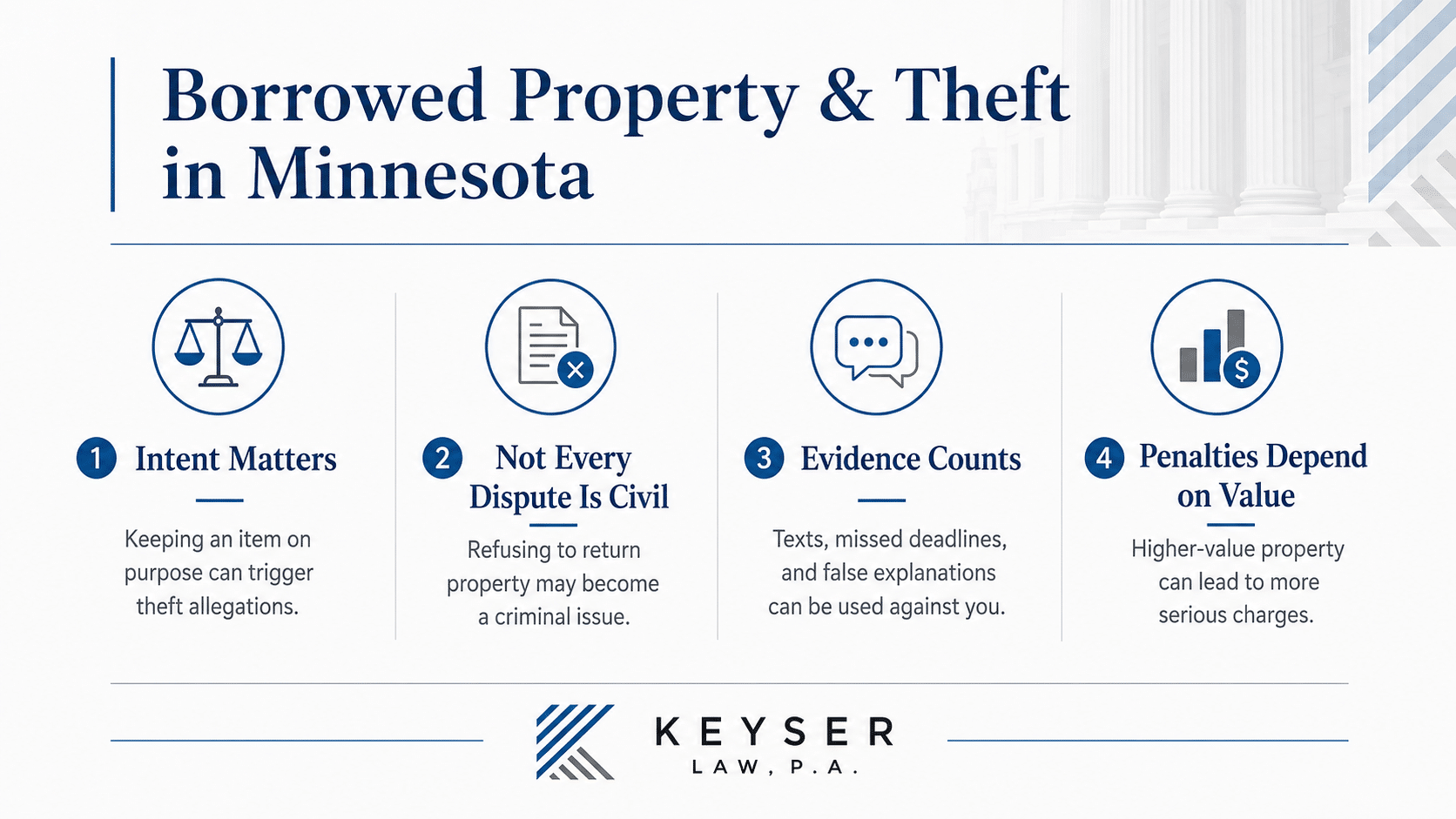
What matters most in these cases is intent at the time of retention or use. If the circumstances suggest that the person no longer intended to return the item, prosecutors may treat the situation as theft rather than a civil disagreement. Lawyers usually rely on evidence such as messages, duration of possession, refusal to communicate, or inconsistent explanations to prove the case.
Theft Offenses and Penalties in Minnesota
Minnesota treats theft as a single offense category, but the way a case is charged and sentenced depends heavily on the value of the property, the circumstances of the conduct, and whether aggravating factors are present. That means two theft cases that look identical on the surface can lead to very different legal outcomes once prosecutors apply the statute to the facts.
Theft charges in Minnesota are separated into levels based primarily on value thresholds and specific circumstances of the alleged conduct.
- Lower-value theft cases (usually below $500) may result in misdemeanor or gross misdemeanor penalties, including jail time of up to 90 days or 364 days, depending on classification, along with a $1,000 fine.
- Mid-level felony theft cases (commonly involving $1,000) may carry a potential one-year prison sentence and $3,000 in fines.
- Higher-value theft cases (especially those exceeding $1,000) can result in significantly longer prison exposure, with maximum penalties reaching 10 to 20 years in the most serious categories.
Minnesota law also increases penalties when the theft poses a likely risk of bodily harm or when the property is in a protected category, such as firearms or public funds. These enhancements can elevate what would otherwise be a lower-level offense to a felony, increasing sentencing exposure.
In Minnesota, individuals found guilty of theft not only face the criminal consequences specified by law but may also be held liable for civil damages under Minnesota Statutes § 604.14. This statute states that the offender is civilly liable to the original owner of the property, and that the compensation owed is based on the property’s value at the time of the theft.
Frequently Asked Questions About Borrowed Property & Theft in MN
Is it a crime if you don’t return something you borrowed?
Yes, under Minnesota Statutes § 609.52, failing to return borrowed property can be prosecuted as theft if there is evidence that you intentionally kept the item to deprive the owner of its value or control. While a simple misunderstanding is a civil matter, a persistent refusal to return an item can elevate the dispute into a criminal offense.
Can you go to jail for keeping someone’s property in Minnesota?
Yes. The criminal penalties for theft in Minnesota are determined by the monetary value of the unreturned property. Keeping an item valued at under $500 is a misdemeanor punishable by up to 90 days in jail. However, if the borrowed item is valued over $1,000, prosecutors can file felony charges, which carry severe state prison sentences and permanent criminal records.
How do prosecutors prove a borrowed item was stolen?
To secure a theft conviction for borrowed property, Minnesota prosecutors must prove criminal intent. They look at specific behavioral evidence, such as:
- Ignoring or blocking the owner’s texts, emails, or phone calls.
- Keeping the item significantly past an agreed-upon deadline.
- Attempting to sell, alter, or hide the property.
- Providing inconsistent or demonstrably false explanations for why the item hasn’t been returned.
Protect Your Future Against Minnesota Theft Allegations
A simple property dispute or a late return can quickly spiral into a high-stakes criminal investigation. In Minnesota, a theft conviction on your record can permanently derail your career path, disqualify you from future employment opportunities, and jeopardize your personal freedom. If a private disagreement has crossed the line into an active criminal accusation, you need strategic legal protection immediately.
As a Board-Certified Criminal Law Specialist, attorney Christopher Keyser brings extensive courtroom experience in handling complex property and financial allegations across Minnesota state and federal courts. Keyser Law, P.A. will dissect the state’s evidence, challenge assertions of criminal intent, and build a sophisticated defense tailored to preserve your reputation and your clean record.
Contact Keyser Law P.A. immediately to understand your options.
How to Build Your Defense Strategy Today:
- Step 1: Request a Free Case Review
Submit a secure case evaluation online, email chris@keyserdefense.com, or call our office lines directly to connect with our legal team:
- Twin Cities Metro Line: (612) 338-5007
- Stillwater Office Line: (651) 689-4788
- Step 2: Connect Directly with a Board-Certified Specialist
Consult either in person or virtually with Christopher Keyser to walk through the exact timeline of your property dispute, evaluate communication logs, and identify weaknesses in the state’s case.
- Step 3: Deploy a Proactive Legal Defense
Establish an aggressive, immediate framework designed to clear up misunderstandings, prevent formal charges from being filed, or push for an outright dismissal in court.
