




Minnesota’s new felony grooming law allows prosecutors to charge an adult before any sexual contact occurs. Effective August 1, 2026, the law makes grooming a felony when an adult expresses sexual intent toward a child and engages in a deliberate pattern of conduct intended to build a false trusting relationship and manipulate the child toward future sexual conduct.
A conviction can carry up to five years in prison, a fine of up to $10,000, or both. Depending on the allegations, prosecutors may also pursue other offenses involving solicitation or criminal sexual conduct.
The new law has specific elements. Ordinary mentoring, coaching, friendliness, or repeated communication with a young person does not by itself establish grooming under Minnesota law. Before answering questions from police, school officials, or investigators, it can be important to speak with a Minneapolis sex crimes lawyer about whether the alleged conduct actually satisfies the statute.
What Counts as Grooming Under Minnesota’s New Felony Law?
Minnesota’s grooming offense is found in Minnesota Statutes § 609.352. For the base grooming offense, the accused must be at least 18 years old.
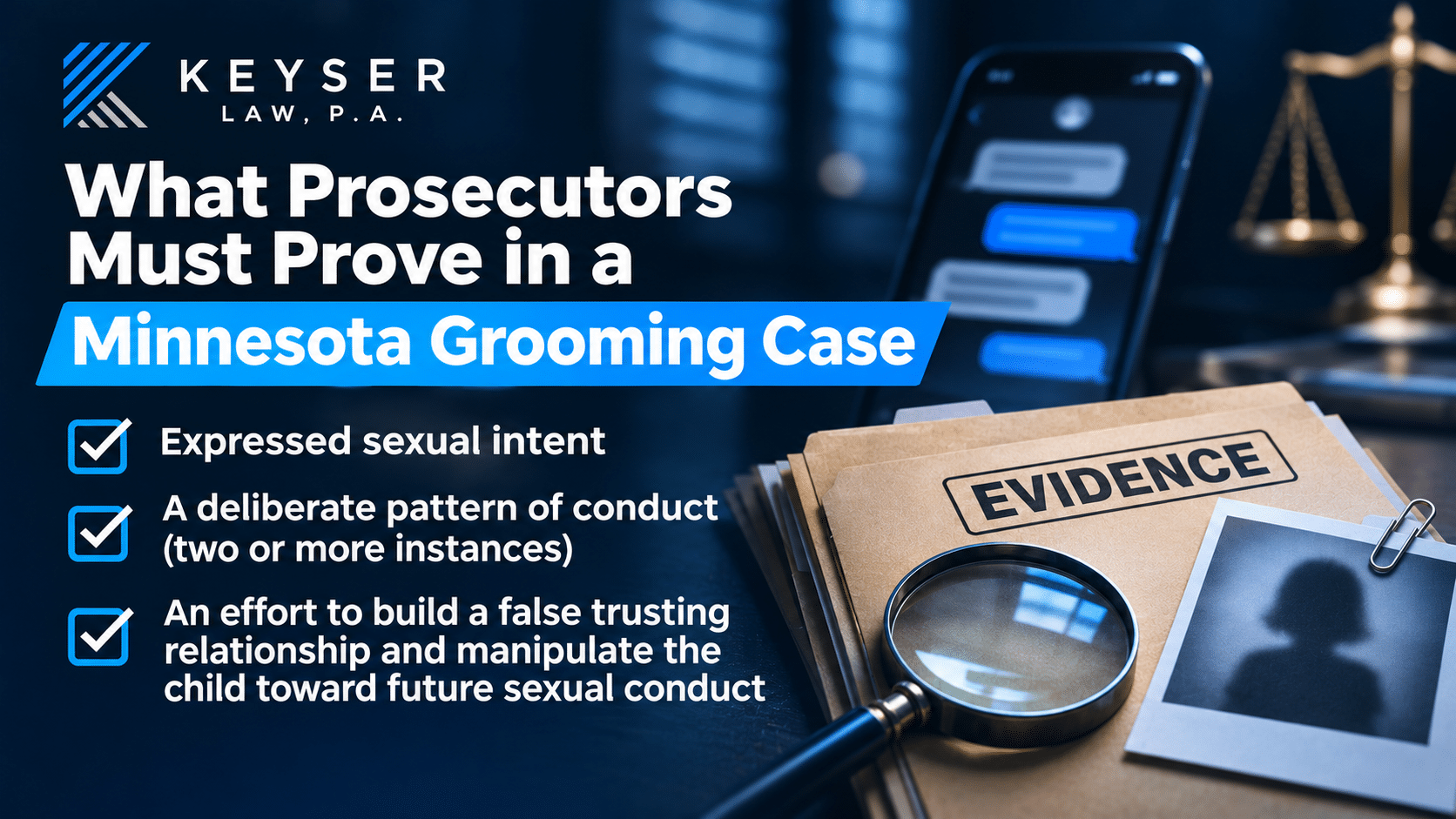
Prosecutors must establish two central elements:
- The adult expressed to the child a desire or intent to engage in sexual conduct with that child; and
- The adult engaged in a deliberate pattern of conduct designed to methodically develop a false trusting relationship with the child and strategically manipulate the child toward sexual conduct at a future time.
Importantly, the statute does not require sexual contact to actually occur. The offense focuses on the alleged intent and course of conduct leading toward future sexual activity.
Minnesota law defines a “pattern” as two or more instances of conduct. That does not mean any two communications automatically amount to grooming. The state must still connect the alleged pattern to the statutory requirements involving sexual intent, a false trusting relationship, and strategic manipulation.
Who Does Minnesota’s Grooming Law Protect?
For the base grooming offense, Minnesota Statutes § 609.352 defines a child as a person who is 15 years old or younger.
The 2026 legislation also expanded protections involving older minors in certain relationships where the legislature determined there may be a heightened risk of exploitation.
People in Positions of Authority
A person can face a felony under the statute when the alleged conduct involves someone under 18 if:
- The accused is in a current or recent position of authority over the alleged victim;
- The accused is more than 36 months older than the alleged victim; and
- The alleged victim is under 18.
The definition of a position of authority can become important in these cases because the nature and timing of the relationship may affect whether this provision applies.
School Employees and Contractors
The law also contains a separate provision involving people employed by or contracted to provide services for an elementary, middle, or secondary school.
If the alleged conduct falls within the prohibited acts covered by the statute and the alleged victim is enrolled as a student at that school, the school-related felony provision can apply regardless of the student’s age.
These provisions were part of Minnesota’s 2026 legislation creating the new grooming offense.
What Are the Penalties for Grooming in Minnesota?
A conviction for grooming under Minnesota Statutes § 609.352 is a felony punishable by:
- Up to five years in prison;
- A fine of up to $10,000; or
- Both imprisonment and a fine.
The same statutory maximum applies to the related felony provisions involving qualifying positions of authority and school employees or contractors.
The statutory maximum is not necessarily the sentence a person would receive after a conviction. Sentencing can depend on the specific offense, criminal history, sentencing guidelines, plea negotiations, and other circumstances.
The consequences may also extend beyond incarceration and fines. A felony conviction can affect employment, professional licensing, reputation, housing, and other areas of a person’s life.
Additional Consequences for Minnesota Teachers
For licensed educators, an accusation can carry professional consequences in addition to the criminal case.
The 2026 legislation added grooming to offenses that can trigger teacher-license consequences. It also requires law enforcement to notify the appropriate licensing board when a teacher is charged with certain serious offenses covered by Minnesota’s educator-licensing laws.
That means educators accused of grooming may need to consider both the criminal case and the potential effect on their professional license and career.
How Prosecutors May Build a Minnesota Grooming Case
Many grooming investigations are likely to depend heavily on digital evidence and the history of communications between the accused and the alleged victim.
Evidence may include:
- Text messages
- Social media messages and direct messages
- Photos or videos
- Phone and app records
- Witness statements
- School or employment records
- Testimony about prior conversations or interactions
The existence of repeated communication does not resolve the case on its own. Prosecutors must connect the evidence to the elements of the grooming statute, including the required sexual intent and the alleged effort to create a false trusting relationship for the purpose of future sexual conduct.
Why Context Matters in Text Messages and Social Media Evidence
Digital communications can be particularly important in a grooming investigation, but individual screenshots or excerpts do not always show the full context of a conversation.
A screenshot may omit earlier or later messages, replies from the other participant, dates, usernames, metadata, deleted material, or other information that changes how a message should be understood. Questions can also arise about who controlled an account or device and whether the material provided to investigators is complete and authentic.
The defense may therefore need to examine the entire communication history rather than relying only on selected messages identified by investigators or another witness.
Context can also matter when prosecutors attempt to characterize otherwise lawful interactions as evidence of a deliberate effort to build a false trusting relationship. Coaching, teaching, mentoring, family relationships, employment, and other legitimate interactions can involve repeated communication with young people. Under the statute, what matters is whether the state can prove the specific prohibited purpose and intent.
What Must Prosecutors Prove in a Minnesota Grooming Case?
The new law does not criminalize every inappropriate, uncomfortable, or poorly judged interaction between an adult and a minor. To obtain a conviction for grooming, the state must prove the statutory elements beyond a reasonable doubt.
Important questions can include:
- Was sexual intent actually expressed? The statute requires an expression to the child of a desire or intent to engage in sexual conduct with that child.
- Was there a deliberate pattern? Minnesota defines a pattern as at least two instances of conduct, but the prosecution must still establish that the conduct was deliberate and connected to the prohibited purpose.
- Was a false trusting relationship being developed? Repeated communication or a trusting relationship alone does not necessarily satisfy this element.
- Was the purpose strategic manipulation? The state must connect the relationship-building conduct to an intent to manipulate the child toward future sexual conduct.
- Can the state prove who sent the communications? Account ownership, device access, authentication, and the completeness of digital evidence may all matter.
Because the grooming statute is new, careful attention to its exact language can be especially important when determining whether alleged conduct actually falls within the offense.
Potential Defenses to a Grooming Charge in Minnesota
A defense to a Minnesota grooming charge may focus on one or more elements the prosecution cannot prove. The appropriate defense depends on the allegations and evidence in the particular case.
No expressed sexual intent. The statute requires an expression to the child of a desire or intent to engage in sexual conduct. Friendly, supportive, affectionate, or even inappropriate communications do not automatically establish that element.
No deliberate pattern of grooming. A single interaction does not meet the statutory definition of a pattern. Even when multiple interactions occurred, the state must prove that they formed a deliberate course of conduct aimed at creating the type of false trusting relationship described by the statute.
No intent to strategically manipulate the child. The prosecution must prove more than the existence of trust between an adult and a young person. The relationship must allegedly have been developed for the prohibited purpose identified by the law.
Context can change the meaning of communications. Selected texts or screenshots can create a different impression when separated from the full conversation. Obtaining the complete message history can be important.
Identity or authenticity problems. Shared devices, compromised accounts, fake profiles, altered screenshots, missing metadata, or incomplete records can raise questions about who sent a communication and whether the evidence accurately reflects what occurred.
Timing. The new grooming offense became effective August 1, 2026, and applies to crimes committed on or after that date. Conduct predating the law cannot simply be prosecuted retroactively as the new grooming offense.
Mistake about the child’s age is not a statutory defense under § 609.352. The statute also provides that the involvement of an undercover operative or law enforcement officer in detecting or investigating an offense does not itself create a defense.
Can Police Search a Phone or Social Media Account in a Grooming Investigation?
Digital evidence does not become admissible simply because investigators believe it may be relevant.
Depending on how police obtained a phone, computer, social media account, cloud account, or other digital information, constitutional and evidentiary issues may arise.
A Minnesota criminal defense attorney can examine whether law enforcement relied on consent, a search warrant, another legal exception, or information provided by a third party. The scope of a warrant and how digital evidence was obtained may also be important.
If prosecutors add allegations of criminal sexual conduct, the case may require a broader Minnesota criminal sexual conduct defense in addition to challenging the grooming charge itself.
What Should You Do if You Are Accused of Grooming in Minneapolis?
An accusation of grooming can begin with a complaint from a parent, school administrator, employer, alleged victim, or another person. In other situations, the first indication may be a call from a detective, a request for an interview, a search warrant, or the seizure of a phone or computer.
Do not delete messages, accounts, photos, or other potential evidence. Destroying or altering evidence can create additional problems and may eliminate information that could have helped explain the full context of the accusation.
It is also generally unwise to try to resolve the accusation by contacting the child, the child’s family, witnesses, school officials, or investigators before obtaining legal advice. Attempts to explain what happened can create additional evidence or be interpreted differently than intended.
Instead, preserve the evidence and speak with an attorney who can evaluate the allegations, communications, timeline, and investigative process before deciding how to respond.
Minnesota Is Expanding Grooming Awareness and Mandatory-Reporter Training
The new criminal offense is part of a broader Minnesota effort involving grooming allegations and student safety.
By August 1, 2027, the Minnesota Department of Children, Youth, and Families, in consultation with the Department of Education, must update mandated-reporter training for education professionals. The updated training must address grooming and threatened sexual abuse, including how to identify signs of grooming and the duty to report grooming as maltreatment.
The Minnesota House has published a summary of the 2026 grooming legislation and related education provisions.
As awareness and reporting requirements expand, accusations may increasingly arise from schools, mandated reporters, parents, or institutional investigations before police ever file a criminal charge.
Defend Against a Grooming Accusation With a Minneapolis Sex Crimes Lawyer
A grooming allegation can threaten far more than a person’s immediate freedom. A felony accusation can affect employment, professional licensing, reputation, family relationships, and future opportunities even before the case is resolved.
At Keyser Law, P.A., the defense begins with the actual evidence: the messages, accounts, devices, timeline, witnesses, and circumstances surrounding the alleged relationship. The next question is whether prosecutors can prove every element Minnesota’s new grooming statute requires.
Christopher Keyser is an MSBA-certified criminal law specialist who represents clients facing serious criminal allegations in Minneapolis and throughout Minnesota.
If you are under investigation, have been contacted by law enforcement, or have already been charged, contact Keyser Law, P.A. to discuss the accusation and your options before making statements that could affect your defense.
