




Identity theft penalties in Minnesota can range from a misdemeanor punishable by up to 90 days in jail to a felony punishable by up to 20 years in prison. The potential charge level usually depends heavily on two numbers: the total financial loss and the number of people whose identities were used. A conviction can also require substantial restitution to affected victims.
Identity theft cases can become more complicated when prosecutors add related allegations involving financial transaction card fraud, check forgery, aggravated forgery, mail theft, theft by swindle, or other fraud charges. A Minneapolis identity theft lawyer can examine where a case falls within Minnesota’s penalty structure and what the prosecution must still prove.
How Minnesota Defines Identity Theft
Under Minnesota Statutes § 609.527, identity theft generally involves transferring, possessing, or using another person’s identity with the intent to commit, aid, or abet unlawful activity.
An identity can include a name, identifying number, or other information that identifies a person or business. Examples include a Social Security number, date of birth, driver’s license number, bank account number, or financial transaction card number.
Minnesota law has also expanded to address newer forms of identity misuse. A 2026 amendment added a person’s voice or likeness, including a digitally forged likeness, to the information that may fall within the statutory definition of identity.
The statute distinguishes between direct victims, whose identities were transferred, used, or possessed, and indirect victims, who suffered financial loss because of the alleged conduct.
The state must also prove the required criminal intent. Possession of identifying information alone does not necessarily establish identity theft if the prosecution cannot prove it was possessed or used with the intent the statute requires.
Minnesota Identity Theft Penalties by Loss and Number of Victims
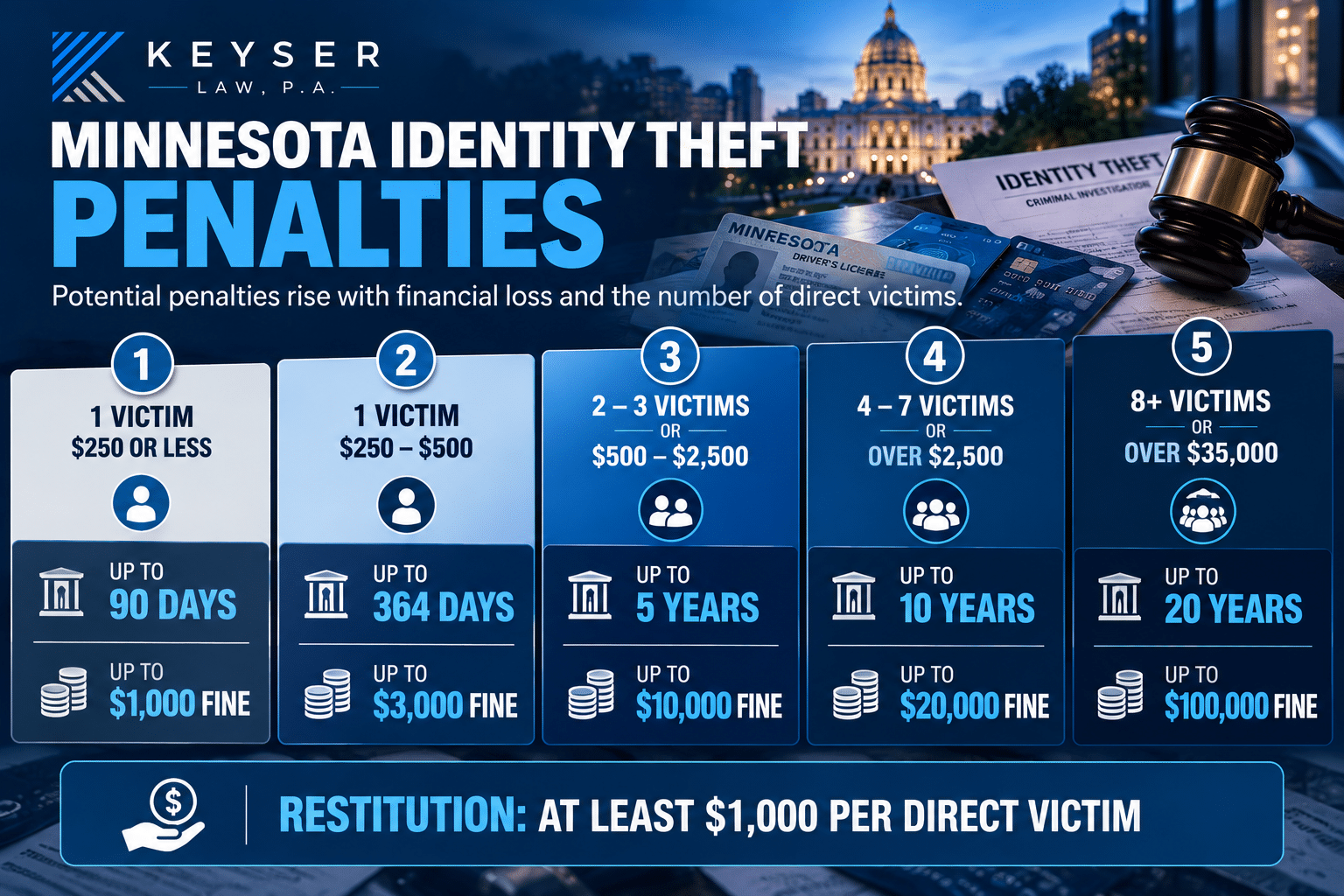
Minnesota’s identity theft penalties increase primarily based on the amount of loss or the number of direct victims.
- One direct victim and a loss of $250 or less: up to 90 days in jail and a fine of up to $1,000.
- One direct victim and a loss over $250 but not more than $500: up to 364 days in jail and a fine of up to $3,000.
- Two or three direct victims, or a loss over $500 but not more than $2,500: up to 5 years in prison and a fine of up to $10,000.
- Four to seven direct victims, or a loss over $2,500: up to 10 years in prison and a fine of up to $20,000.
- Eight or more direct victims, a loss over $35,000, or certain identity theft connected to child sexual abuse material: up to 20 years in prison and a fine of up to $100,000.
A court may impose incarceration, a fine, or both, depending on the offense and the case’s circumstances.
The amount of loss can become an important issue in the defense. Minnesota law allows the calculation to include both the value obtained and qualifying crime-related expenses. If the state’s loss calculation is inaccurate or unsupported, challenging that amount can affect the charge level and available penalties.
Prosecutors may also aggregate certain conduct occurring within a six-month period when calculating the number of victims or amount of loss. That can turn a series of lower-dollar allegations into a substantially more serious case.
Phishing and Card-Skimming Offenses Under Minnesota Identity Theft Law
Minnesota’s identity theft statute also addresses certain methods used to obtain identifying information.
Using an email, website, or other electronic communication to solicit identifying information while falsely representing the identity of a person or organization can fall under Minnesota’s anti-phishing provisions. The law also addresses devices used to scan, record, or capture information encoded on financial transaction cards.
These offenses can carry penalties of up to 5 years in prison and a fine of up to $10,000.
How the Minnesota Sentencing Guidelines Treat Identity Theft
The statutory maximum is not necessarily the sentence a person will receive after a conviction. Minnesota courts also use the Minnesota Sentencing Guidelines to set a presumptive sentencing range based on the offense’s severity and the person’s criminal history score.
The highest identity theft tier is ranked at severity level 8 under the sentencing guidelines. For someone with a criminal history score of zero, that level carries a presumptive prison sentence of 48 months under the current sentencing grid.
Lower felony identity theft tiers are assigned to lower severity levels. At some levels, a person with little or no criminal history may face a presumptive stayed sentence, meaning probation rather than immediate imprisonment.
Prior convictions can increase the criminal history score and change the presumptive sentence. Other circumstances may also affect sentencing, so the statutory maximum alone does not indicate what sentence a person is likely to receive in a particular case.
Restitution in a Minnesota Identity Theft Case
Restitution is another significant consequence of an identity theft conviction.
Minnesota law requires restitution of at least $1,000 for each direct victim. Depending on the circumstances, restitution may also account for additional losses and qualifying expenses suffered by direct or indirect victims.
That means the financial consequences of an identity theft case can extend well beyond a criminal fine. In cases involving multiple identities, mandatory restitution can be substantial even before other claimed losses are considered.
How Long Does Minnesota Have to File an Identity Theft Charge?
The statute of limitations can also depend on the seriousness of the alleged identity theft.
Under Minnesota Statutes § 628.26, prosecutors generally have three years to bring many identity theft charges. A five-year limitations period applies to certain more serious cases, including allegations involving eight or more direct victims or a combined loss exceeding $35,000.
Venue can also be broader than people expect. Prosecutors may prosecute an identity theft case in the county where the alleged offense occurred or where a victim resides or does business, depending on the circumstances.
Related Fraud Charges That Can Accompany Identity Theft in Minnesota
Identity theft rarely stands alone. Prosecutors may charge multiple financial crimes arising from the same alleged conduct.
Depending on the facts, related charges can include:
- Financial transaction card fraud
- Check forgery
- Aggravated forgery
- Mail theft
- Theft by swindle
- Other state or federal fraud offenses
Minnesota’s financial transaction card laws cover more than traditional credit cards. They can also apply to debit cards and other cards used to obtain money, goods, services, or benefits.
The penalty for each related charge depends on its own statutory elements, loss thresholds, and other facts. A Minneapolis criminal defense lawyer should therefore examine each count separately rather than treating the case as a single identity theft allegation.
What Can Be Challenged in an Identity Theft Case?
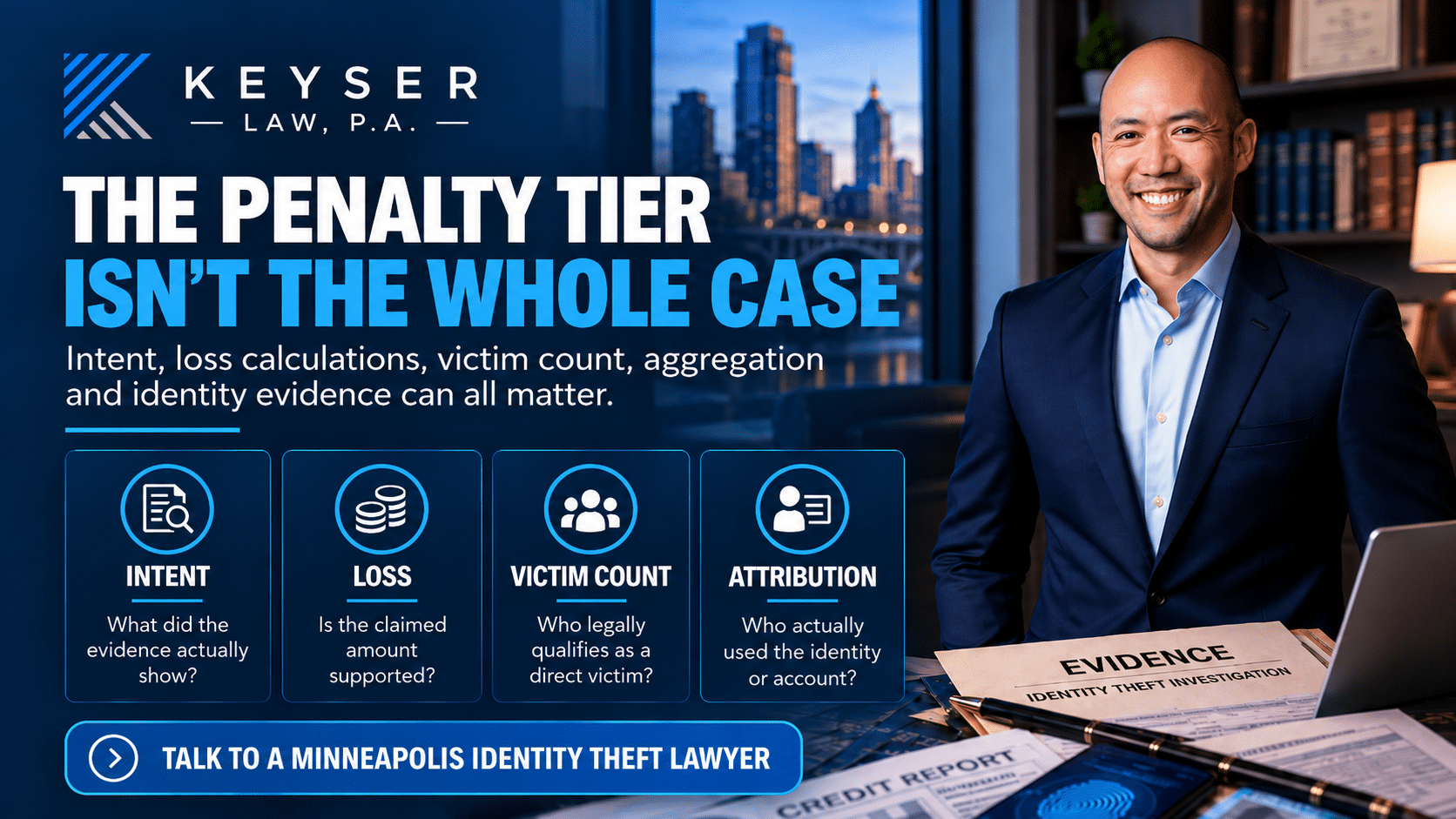
The penalty chart does not answer whether the prosecution can actually prove the charge. Several issues can materially affect an identity theft case.
Intent. The state must establish the required intent to commit, aid, or abet unlawful activity. The existence of another person’s identifying information does not, by itself, explain why it was possessed or how it was used.
Loss amount. Because Minnesota’s penalty tiers depend heavily on financial loss, the defense can examine how prosecutors calculated the claimed amount and whether the law can legally attribute each loss to the alleged conduct.
Number of victims. The number of direct victims can independently move an identity theft allegation into a more serious penalty tier. The defense can examine whether each person the prosecution counts as a direct victim qualifies under the statute.
Aggregation. When prosecutors combine losses or victims from multiple incidents, the defense can examine whether Minnesota law allows those allegations to be legally aggregated.
Identity and attribution. Digital records, account access, devices, IP information, and financial records do not always establish who actually carried out a transaction. The connection between a defendant and the alleged use of another person’s identity can therefore become a central issue.
Related charges. Card fraud, forgery, mail theft, and other allegations have their own elements. Evidence supporting one count does not automatically establish every other count filed in the case.
Frequently Asked Questions About Minnesota Identity Theft Penalties
Is identity theft always a felony in Minnesota?
No. Minnesota identity theft can be charged at different levels depending on the loss amount, number of direct victims, and other circumstances. The lowest tier involving one direct victim and a loss of $250 or less can be prosecuted as a misdemeanor, while more serious cases can carry felony penalties of up to 20 years in prison.
How does the amount of financial loss affect an identity theft charge?
Loss is one of the primary factors Minnesota uses to determine the penalty level. Higher alleged losses can move a case into increasingly serious felony categories, so how the loss is calculated can be an important issue in the defense.
Can prosecutors combine multiple victims or losses in one identity theft case?
Yes, in some circumstances. Minnesota law allows prosecutors to aggregate certain losses and victims that occur within a six-month period when determining the applicable penalty level. Whether the alleged conduct qualifies for aggregation depends on the facts and the statute.
Does a Minnesota identity theft conviction require restitution?
Yes. Minnesota law requires the court to order at least $1,000 in restitution for each direct victim of identity theft. Additional restitution may also be ordered based on the losses and qualifying expenses associated with the offense.
Face Minnesota Identity Theft Charges With a Minneapolis Identity Theft Lawyer
An identity theft charge can involve much more than determining whether someone used your information.
The alleged loss amount, the number of victims, how multiple transactions are grouped, and whether the state can prove criminal intent can all affect the case’s seriousness.
Christopher Keyser is an MSBA-certified criminal law specialist. Keyser Law, P.A. can review loss calculations, victim count, digital and financial evidence, related charges, and the prosecution’s evidence used to prove intent.
Keyser Law, P.A. represents people facing serious fraud and financial crime allegations in Minneapolis, Stillwater, and throughout Minnesota. If you are under investigation or have already been charged, contact Keyser Law, P.A. to discuss your case.
