



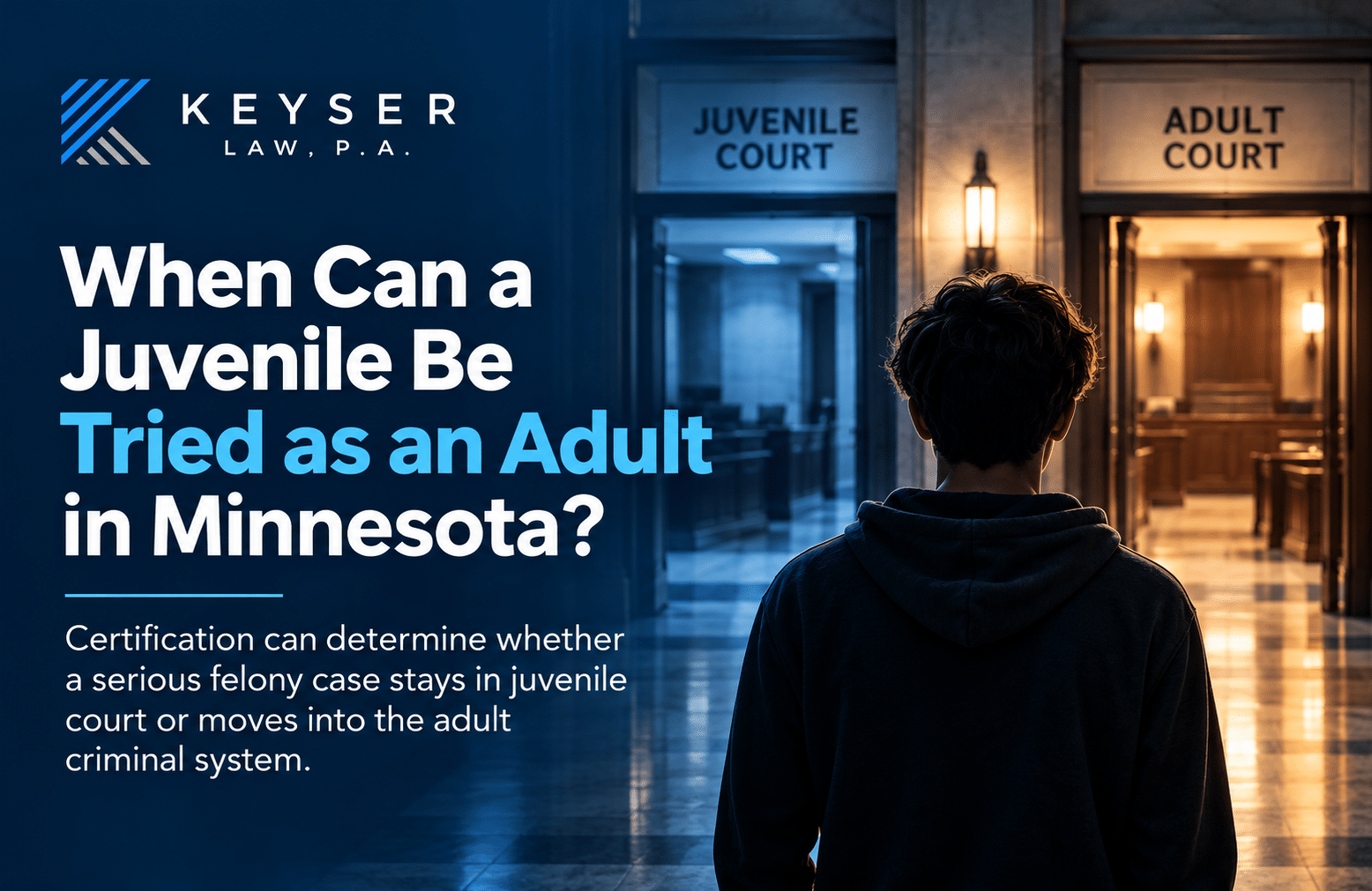
In Minnesota, a juvenile age 14 or older who is accused of conduct that would be a felony if committed by an adult can potentially be certified for adult prosecution. Certification is not automatic in most cases. A prosecutor must ask the juvenile court to certify the case, and a judge must determine whether the legal requirements for adult prosecution are met under Minnesota Statutes § 260B.125.
There is an important exception: a child who is alleged to have committed first-degree murder after turning 16 may be prosecuted in adult court without the ordinary certification process. Attempted first-degree murder does not fall within that same automatic adult-prosecution rule under Minnesota Statutes § 609.055.
Certification can dramatically change the stakes of a juvenile case. Adult court brings adult criminal procedures, sentencing exposure, and consequences that can follow a young person well beyond adolescence. A Minneapolis juvenile defense lawyer can review the certification motion, the public-safety factors, and the evidence before the hearing.
What Is Juvenile Certification in Minnesota?
Juvenile certification is the process Minnesota uses to determine whether certain felony cases involving young people should move from juvenile court into the adult criminal system.
Under Minnesota Statutes § 260B.125, a prosecutor can seek certification when a child allegedly committed, after turning 14, an offense that would be a felony if an adult committed it. The prosecutor files a certification motion, the court determines whether probable cause exists, and the judge then applies Minnesota’s public-safety standards.
If the court grants certification, the prosecutor proceeds with the case under the laws and procedures that govern adult criminal prosecutions.
When Is Adult Certification Presumed for a 16- or 17-Year-Old?
Minnesota presumes adult certification in certain cases involving 16- and 17-year-olds.
The presumption applies when the delinquency petition alleges an offense that would result in a presumptive commitment to prison under the Minnesota Sentencing Guidelines and applicable statutes, or when the child is accused of committing a felony while using a firearm.
In those cases, once probable cause is established, the burden shifts to the child. The defense must show by clear and convincing evidence that keeping the case in juvenile court serves public safety.
When the presumption does not apply, the burden remains with the prosecutor. The state must prove by clear and convincing evidence that retaining the case in juvenile court would not serve public safety.
What Happens at a Minnesota Juvenile Certification Hearing?
A certification hearing is not a trial on guilt or innocence. It determines whether the case should remain in juvenile court or proceed under adult criminal law.
Minnesota law generally requires the certification hearing to be held within 30 days after the certification motion is filed. If good cause is shown, the hearing may be held within 90 days of the filing of the motion.
The court must also find probable cause to believe the juvenile committed the offense alleged in the delinquency petition. After the hearing, the judge applies the statutory public-safety factors and decides whether certification is appropriate.
What Factors Do Minnesota Courts Consider Before Certifying a Juvenile?
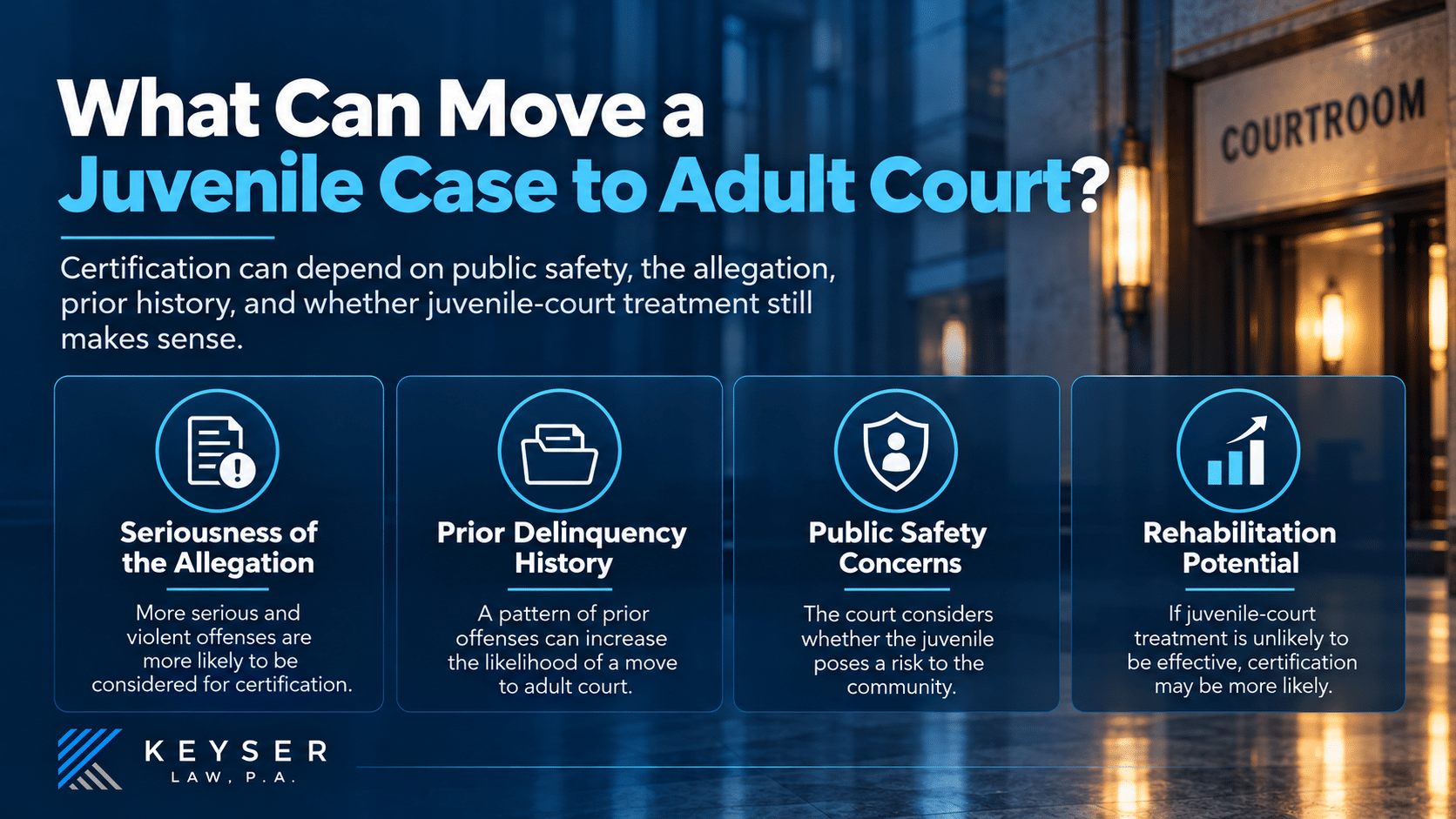
Minnesota judges evaluate six public-safety factors when deciding whether a juvenile case should move to adult court:
- The seriousness of the alleged offense, including aggravating circumstances, firearm use, and the impact on the victim.
- The child’s culpability, including participation in planning or carrying out the alleged offense and relevant mitigating circumstances.
- The child’s prior delinquency record.
- The child’s programming history, including past participation and willingness to engage in services or treatment.
- The adequacy of punishment or programming available in the juvenile system.
- The dispositional options available to the court.
The statute requires the court to weigh the seriousness of the alleged offense and the child’s prior delinquency record more heavily than the remaining factors.
That does not make the other factors unimportant. School records, mental-health or treatment history, family support, developmental information, prior success in programming, and evidence of rehabilitation potential can become important when the defense argues that juvenile court can still protect public safety.
What Is Extended Jurisdiction Juvenile Prosecution?
Extended Jurisdiction Juvenile prosecution, commonly called EJJ, blends ordinary juvenile court with full adult prosecution.
If an EJJ case results in a guilty plea or finding of guilt, the court can impose both a juvenile disposition and an adult criminal sentence. The court stays the adult sentence as long as the young person complies with the juvenile disposition and does not commit a new offense. Minnesota’s EJJ framework is set out in Minnesota Statutes § 260B.130.
If those conditions are violated, the court may revoke the stay and impose the adult sentence.
EJJ can therefore give a young person the opportunity to remain under juvenile-court supervision while carrying the significant risk of an adult sentence if the disposition conditions are not followed. Juvenile-court jurisdiction over an EJJ offense can continue until age 21.
What Happens If Certification Is Denied?
Denying certification does not necessarily mean the case returns to an ordinary juvenile prosecution.
In a presumptive-certification case, Minnesota law generally requires the court to designate the proceeding as EJJ if adult certification is denied. In other cases, the court may also consider EJJ depending on how the proceeding was initiated and its findings.
That makes the certification hearing important even when the defense successfully prevents full adult prosecution. Possible outcomes include ordinary juvenile court, EJJ, or adult court, and each carries very different consequences.
Which Juvenile Charges Can Lead to Adult Court in Minnesota?
Certification is not limited to one category of crime. Because Minnesota Statutes § 260B.125 applies to alleged felony conduct committed after age 14, many serious felony charges can potentially lead to a certification motion.
Examples can include felony assault, robbery, burglary, weapons offenses, serious drug felonies, criminal sexual conduct, and other felony allegations. Whether the prosecution actually seeks certification depends on the child’s age, the charged offense, the evidence, prior delinquency history, and the public-safety factors.
First-degree murder is treated differently. Under Minnesota Statutes § 609.055, a child alleged to have committed first-degree murder after turning 16 may be prosecuted as an adult without ordinary certification. The statute expressly distinguishes attempted first-degree murder, which does not fall under that same provision.
Why the Public-Safety Evidence Matters So Much
The certification decision is driven by evidence, not simply by the name of the charge.
A defense strategy may examine the young person’s role in the alleged offense, prior record, school performance, treatment history, family environment, mental-health or developmental needs, willingness to participate in programming, and the services that remain available through the juvenile system.
In a presumptive-certification case, that evidence can be critical because the defense must show that retaining juvenile jurisdiction serves public safety. In a non-presumptive case, the same evidence can challenge the prosecutor’s claim that juvenile court is inadequate.
What Parents Should Do After Learning the Prosecutor Wants Adult Certification
A certification motion creates a separate proceeding with its own deadlines and evidentiary issues. Families should take it seriously from the beginning rather than waiting to see how the underlying delinquency case develops.
Useful records include school history, treatment records, programming records, evaluations, family information, and other evidence addressing the statutory public-safety factors. The defense also needs time to examine the alleged offense, the child’s level of participation, potential mitigating circumstances, and whether the evidence supports the prosecution’s certification theory.
Early preparation matters because the certification hearing can determine whether the young person remains in a system designed around juvenile rehabilitation or faces prosecution under adult criminal law.
Talk to a Minneapolis Juvenile Defense Lawyer About Adult Certification
A certification motion can determine far more than where a case is heard. It can affect sentencing exposure, the length of court supervision, access to juvenile programming, and the case’s long-term consequences.
Christopher Keyser is an MSBA-certified criminal law specialist. Keyser Law, P.A. can review the delinquency petition, certification motion, probable-cause issues, public-safety evidence, and possible EJJ alternatives before the court decides whether adult prosecution is appropriate.
If your child is facing a certification motion or another serious juvenile charge, contact Keyser Law, P.A. for a confidential consultation.
Frequently Asked Questions About Juvenile Certification in Minnesota
What is the youngest age a juvenile can be certified as an adult in Minnesota?
Certification is generally available when a child allegedly committed, after turning 14, an offense that would be a felony if committed by an adult.
Does a 16- or 17-year-old automatically go to adult court for a serious felony?
No. Some cases involving 16- and 17-year-olds carry a presumption in favor of certification, but the case still goes through the certification process unless another statute gives adult court jurisdiction. In a presumptive case, the defense can attempt to rebut the presumption by showing that retaining the case in juvenile court serves public safety.
What is the difference between adult certification and EJJ?
Adult certification moves the case into the adult criminal system. EJJ keeps the proceeding within the juvenile framework but combines a juvenile disposition with a stayed adult sentence that may be executed if the young person violates the disposition’s conditions or commits a new offense.
Can a juvenile charged with attempted first-degree murder be automatically prosecuted as an adult?
No. Minnesota’s special first-degree-murder provision does not automatically place attempted first-degree murder in adult court. The ordinary certification rules may still apply, depending on the juvenile’s age and the case’s circumstances.
